Only What's Needed (OWN)

Designing India’s first publicly co-created food brand

About
Industry: Food & Nutrition
‍Services: Brand Strategy, Naming, Visual Identity, Packaging Design
‍Approach: Participatory Design + Information Systems
‍Outcome: A transparency-led brand, built with its audience
Year: 2025
Status: Completed, Buy now!
Studio Sorted designed the brand strategy, identity, and packaging system for Only What’s Needed (OWN) — a transparent food brand launched by FoodPharmer, Revant Himatsingka.
We took this on as a pro-bono collaboration, recognising early that this was not just a branding exercise, but a public-interest problem.
Food Pharmer taught India to read food labels. With Only What’s Needed (OWN), people got a say in what went on them. Studio Sorted worked with Revant Himatsingka and the OWN team on brand strategy, naming, visual identity and packaging. Public input shaped the brief. Transparency shaped the design. Together, they gave us a direction: build a food brand that puts its information where its promise is, right in front of you.
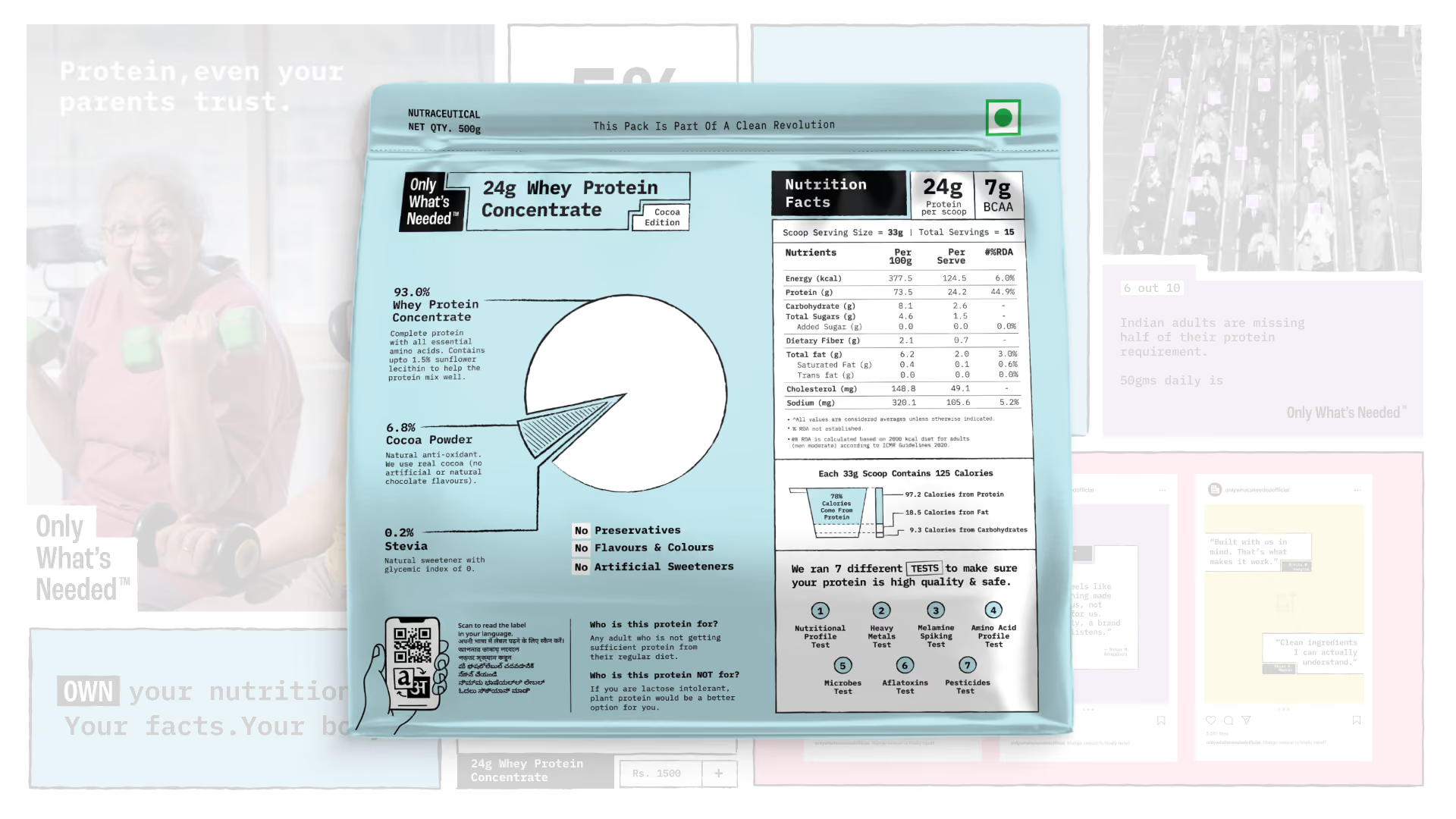
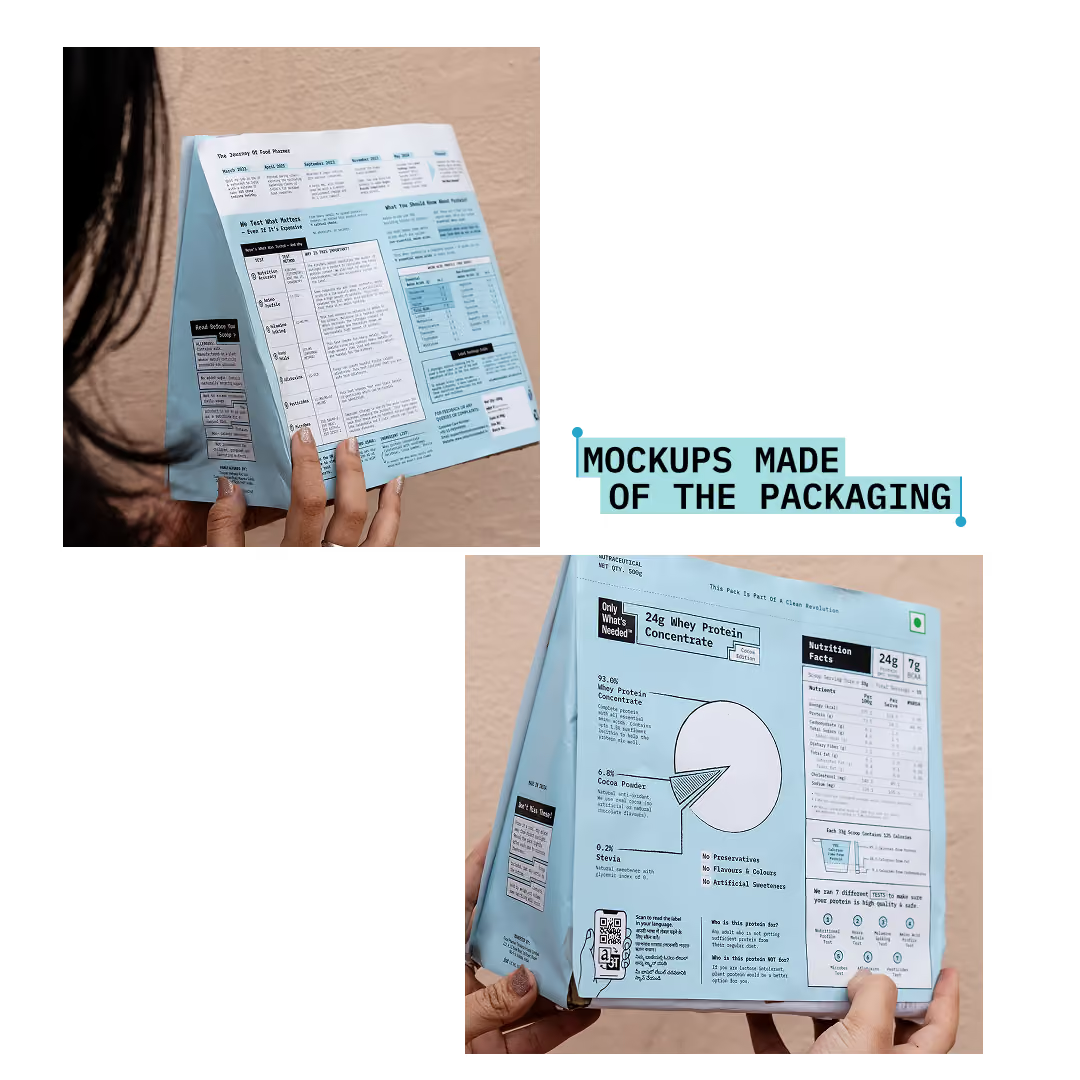
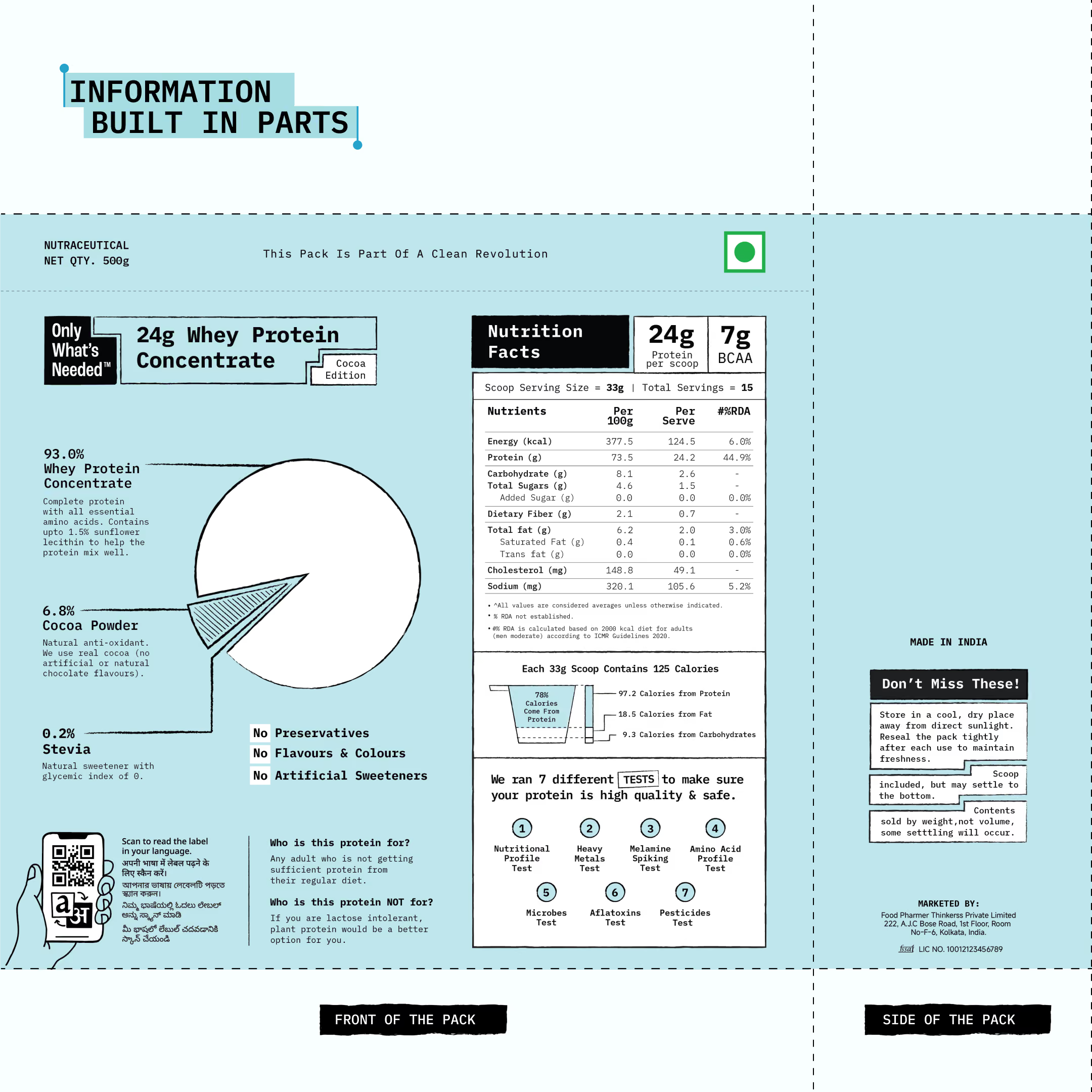
Back of a blue packet labeled '24g Whey Protein Concentrate Cocoa Edition' with nutrition facts, a pie chart showing 93% whey protein concentrate, 6.8% cocoa powder, 0.2% stevia, and details about no preservatives, flavors, colors, or artificial sweeteners, plus a list of 7 safety and quality tests performed on the protein.
Studio Sorted designed the brand strategy, identity, and packaging system for Only What’s Needed (OWN), the transparent food brand launched by FoodPharmer (Revant Himatsingka).
The Context
‍Over the years, FoodPharmer’s Label Padhega India movement has fundamentally changed how people engage with packaged food in India. Millions began reading labels more closely, questioning ingredients, and challenging misleading claims. But this shift exposed a deeper contradiction. Even when people knew what to look for, the way information was presented remained: fragmented, difficult to interpret, buried in hierarchy, shaped by marketing.

Transparency had become a widely used word.
But rarely a designed system.

When you teach people to question labels, your own has to answer.

Read the label. Question the ingredients. Look past the claim on the front. Food Pharmer’s Label Padhega India movement encouraged people to take a closer look at what they were eating. Then came his own food brand.

OWN was going to face the very questions Food Pharmer had taught people to ask. What’s inside? Why is it there? What aren’t you telling us?

Those questions belonged in the brief. So did the people asking them.
Label Padhega India became Label Likhega India.
What flavours would you actually want? What pack size works for you? What do you need to know before buying? OWN opened these questions to its community while the food and brand were taking shape.

2,00,000 people participated in the process.
‍
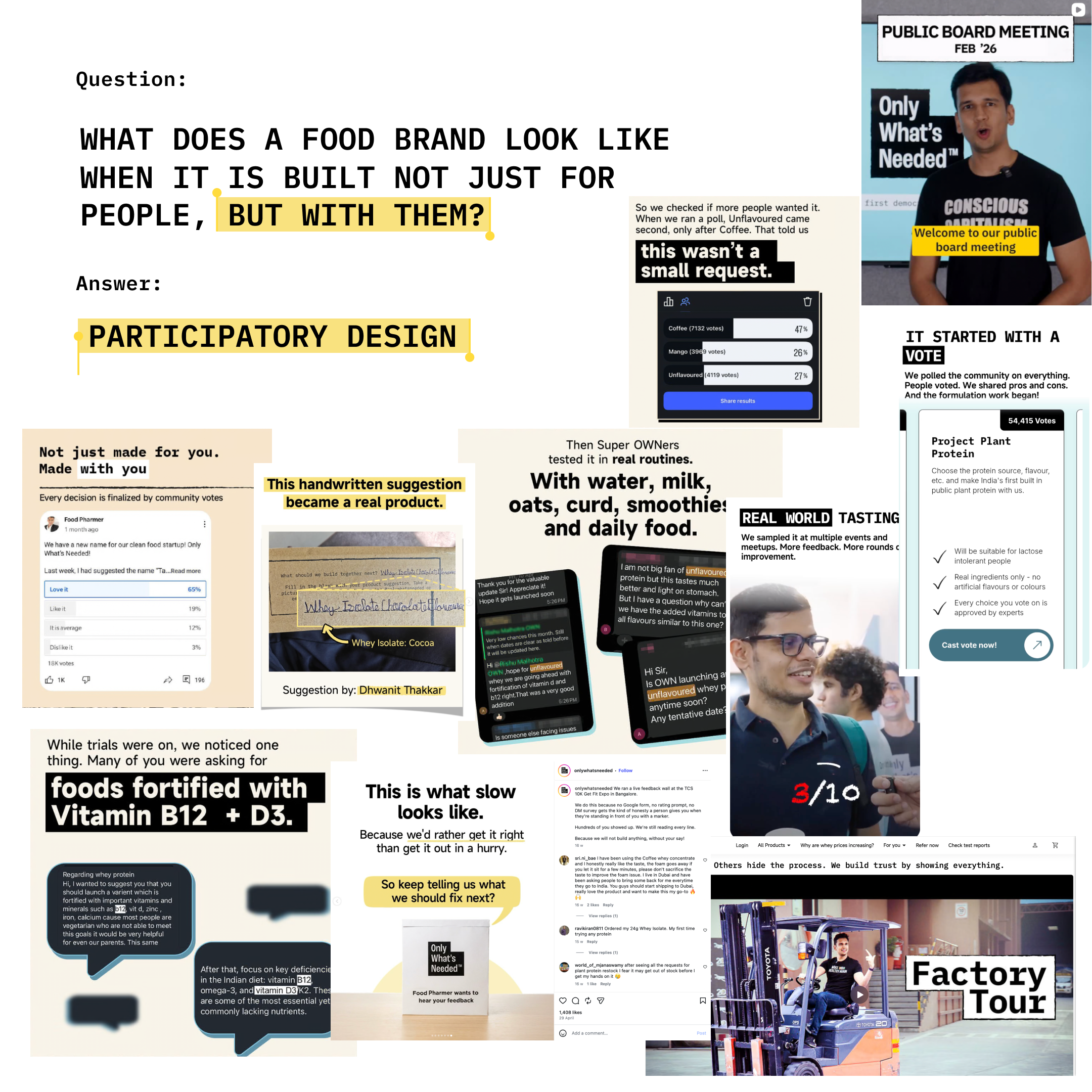
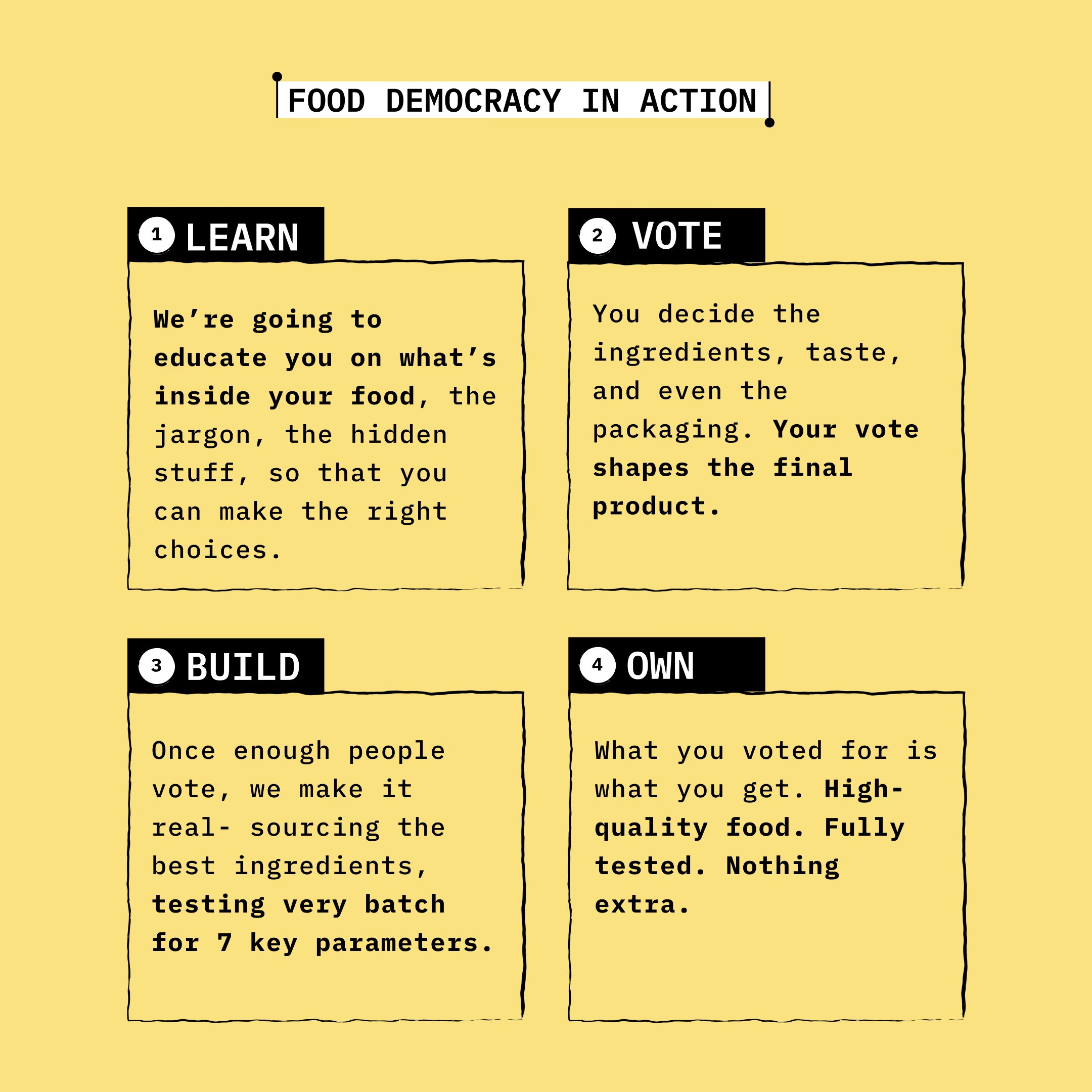
With co-creation at it's core, people could influence what would reach them, from the ingredients to the information on the label.Learn. Vote. Build. Own. The process connected learning about food with having a say in what gets made.

The OWN team had announced a name: Take Charge. People pushed back. We worked with the client on name options for public feedback, and Only What’s Needed was the name people favoured. Opening up the process meant being willing to change something as fundamental as the name.Only What’s Needed puts a useful pressure on the brand. Every ingredient has to earn its place. Every message, too. Shortened to OWN, it also gives the invitation to participate a name of its own.
Collage of images and text showing the process of participatory design for a food brand, emphasizing community involvement and feedback. Key text includes the question 'What does a food brand look like when it is built not just for people, but with them?' and the answer 'Participatory design.' Highlights include community voting results, handwritten product suggestions, real routine testing of the product with water, milk, oats, curd, smoothie, and daily food. Screenshots feature polls, feedback messages requesting addition of vitamins B12 and D3, Instagram comments, and a community vote on a public plant protein product. The collage ends with 'Factory Tour' and images of people engaged in testing and discussion.Graphic titled 'Food Democracy in Action' with four steps: 1. Learn - educating about food contents, jargon, and hidden info to make informed choices. 2. Vote - deciding ingredients, taste, packaging, emphasizing that your vote shapes the final product. 3. Build - after enough votes, sourcing best ingredients and testing batches for 7 parameters. 4. Own - receiving what was voted for: high-quality, fully tested food with nothing extra.
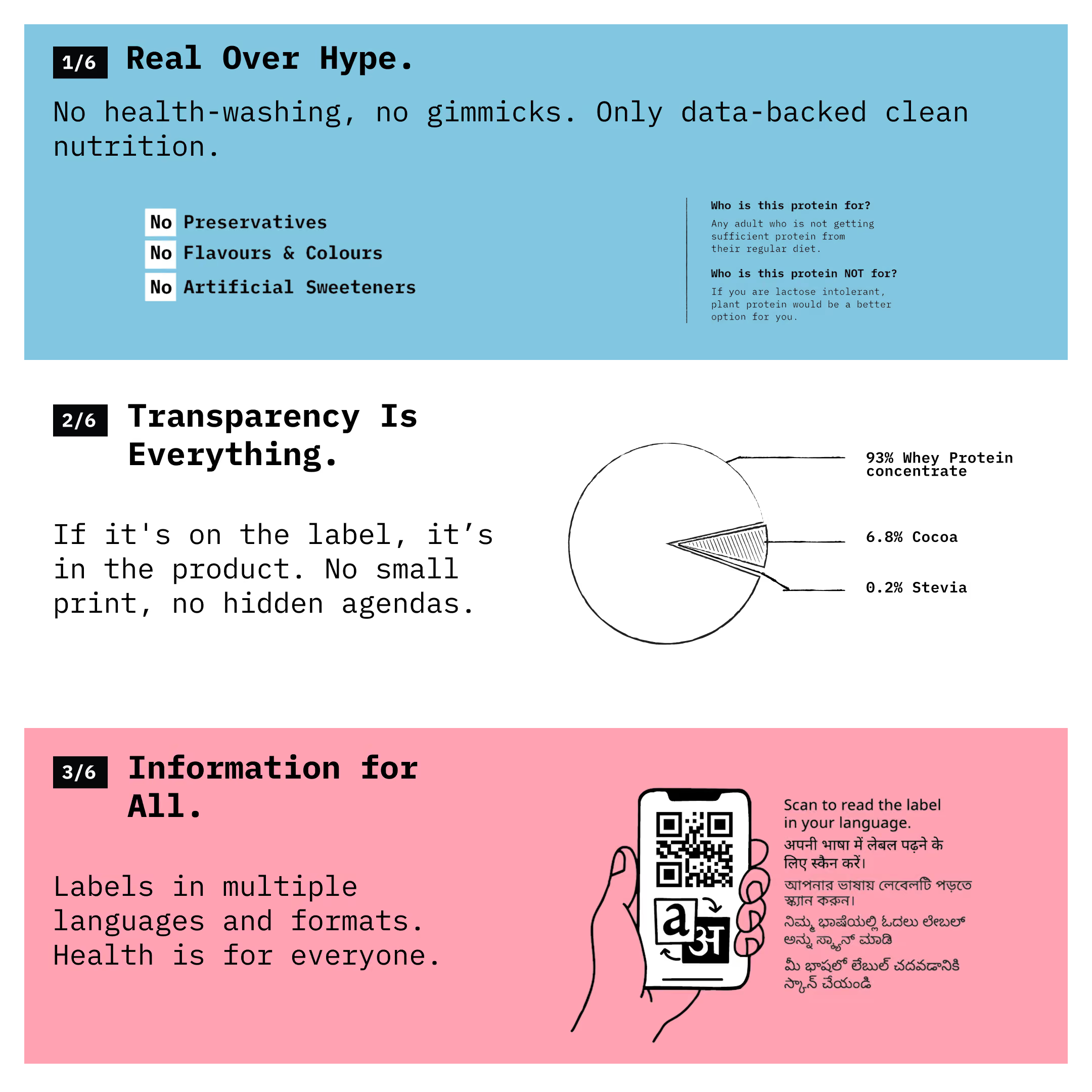
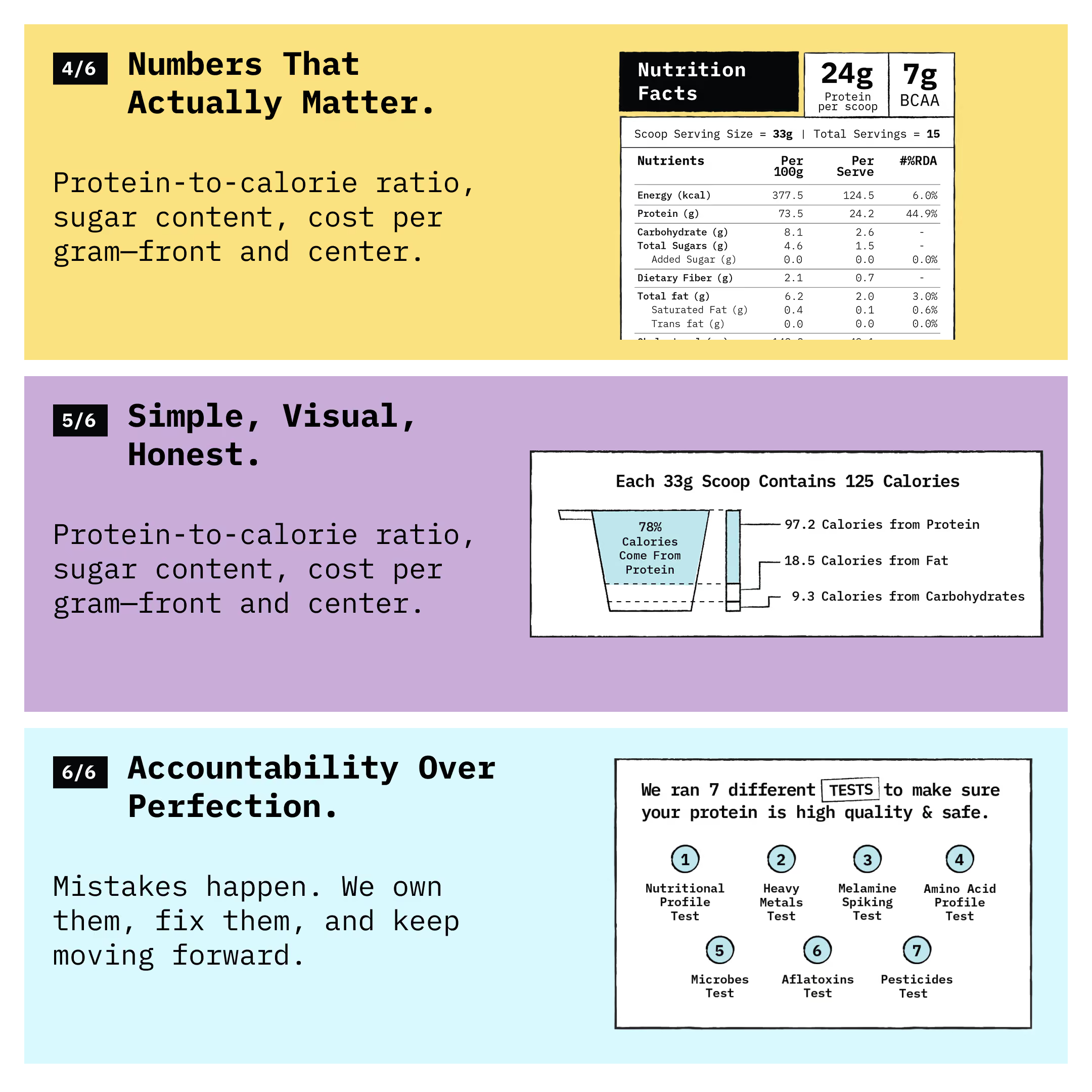
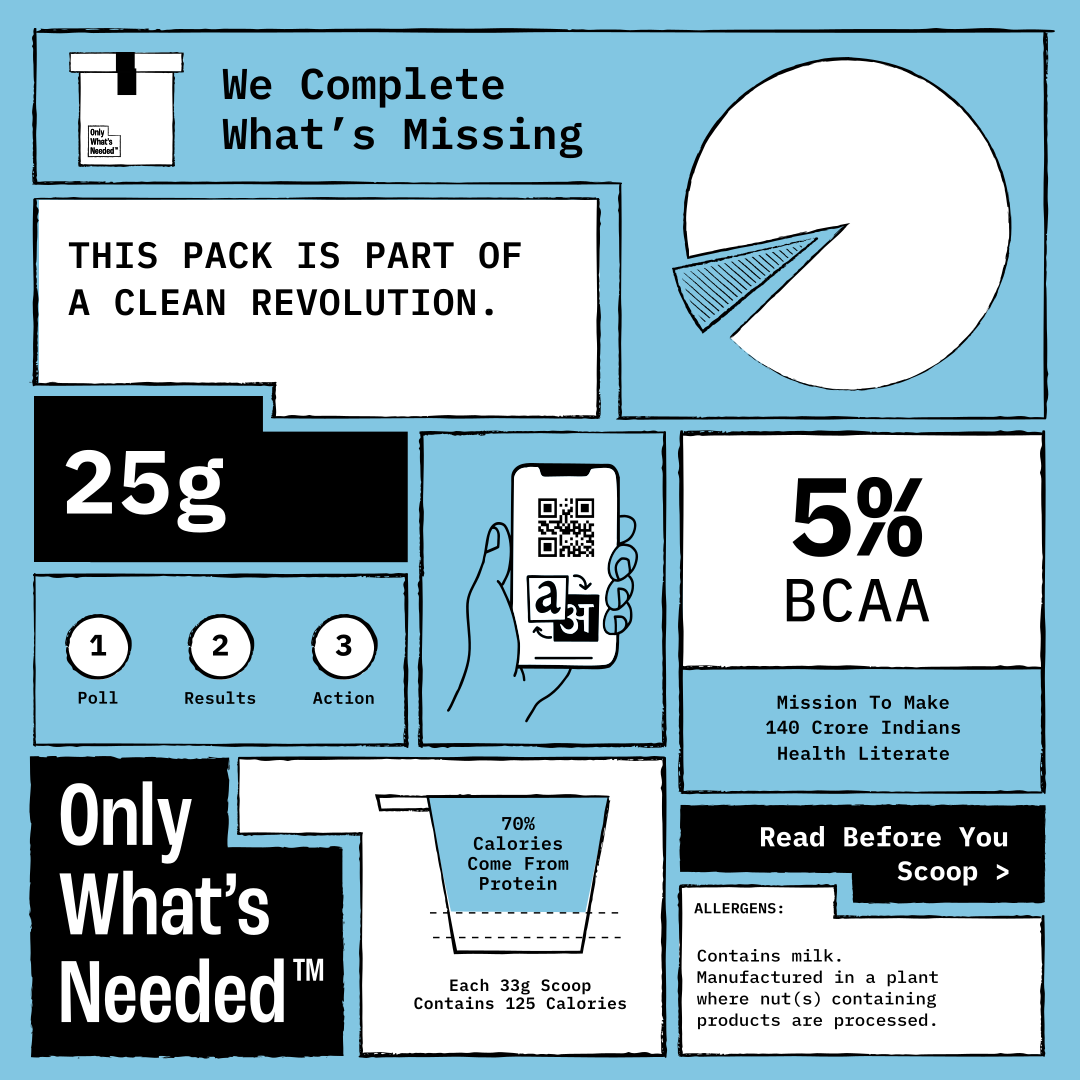
A three-part infographic with text and illustrations outlining product principles. Part 1 (blue background) titled 'Real Over Hype' states no preservatives, flavours, colours, or artificial sweeteners, with notes on who the protein is for and not for. Part 2 (white background) titled 'Transparency Is Everything' shows a pie chart with 93% whey protein concentrate, 6.8% cocoa, and 0.2% stevia, emphasizing no hidden ingredients. Part 3 (pink background) titled 'Information for All' shows a hand holding a phone with a QR code and a message about labels in multiple languages for health accessibility.Three infographic panels highlighting principles about protein supplement quality. Panel 4/6 titled 'Numbers That Actually Matter' on a yellow background shows a nutrition facts label with protein content, calories, sugars, fiber, and fats for a 33g scoop with 24g protein and 7g BCAA. Panel 5/6 titled 'Simple, Visual, Honest' on purple background shows a graphic stating each 33g scoop contains 125 calories, with 78% calories from protein, 97.2 calories from protein, 18.5 calories from fat, and 9.3 calories from carbohydrates. Panel 6/6 titled 'Accountability Over Perfection' on a blue background shows a list of seven tests (nutritional profile, heavy metals, melamine spiking, amino acid profile, microbes, aflatoxins, pesticides) done to ensure protein quality and safety.

The six commandments that shaped the visual identity of Only What's Needed (OWN)

We put the back of the pack on the front.

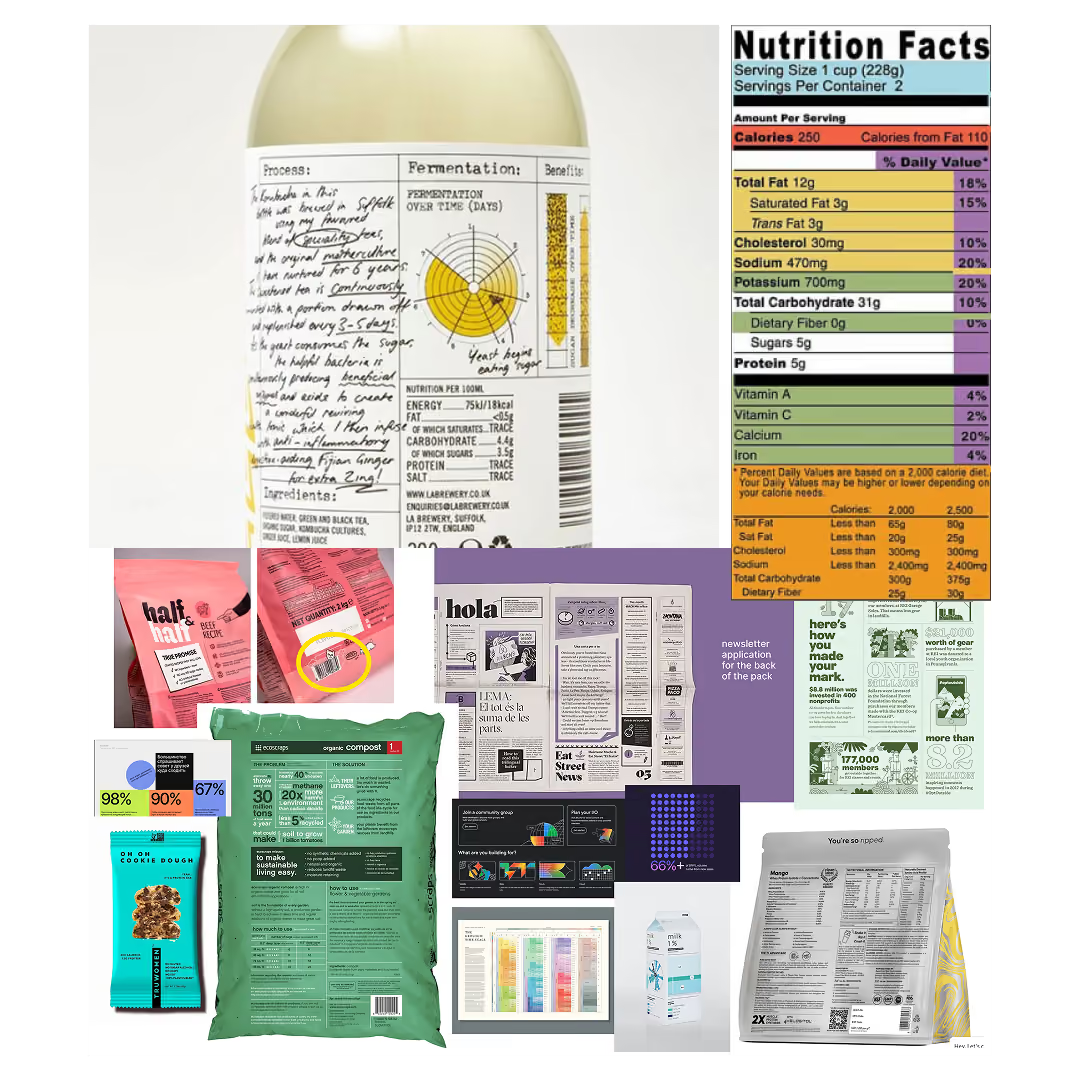
A pack can look healthy long before you read its ingredients. In the category examples we examined, familiar colours, imagery and benefit claims did much of the talking. Composition and nutrition took more work to understand.

For OWN, the question was practical: how do we make the product easier to inspect? The project’s principles helped us make the calls. Real over hype meant questioning shortcuts for “healthy”. Numbers that matter needed space and context. Information for all meant thinking about language and format from the start.

Graphics had to explain something. Copy had to help someone. And accountability meant the brand had to leave room for questions and corrections.
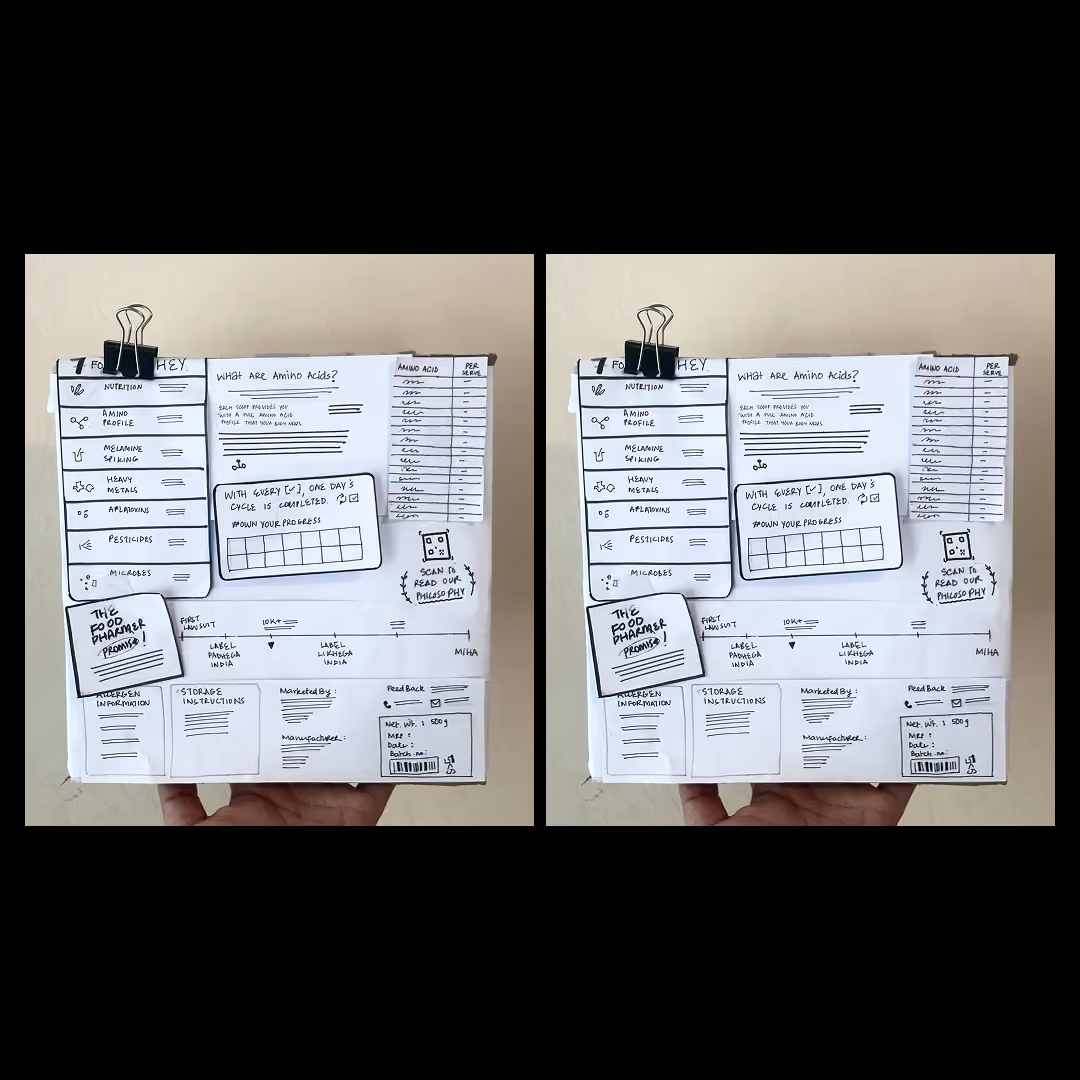
Two side-by-side views of a hand holding a sheet of paper clipped with a black binder clip, resembling a scientific or educational chart about amino acids with handwritten notes, diagrams, and a progress chart, displayed on a beige background.
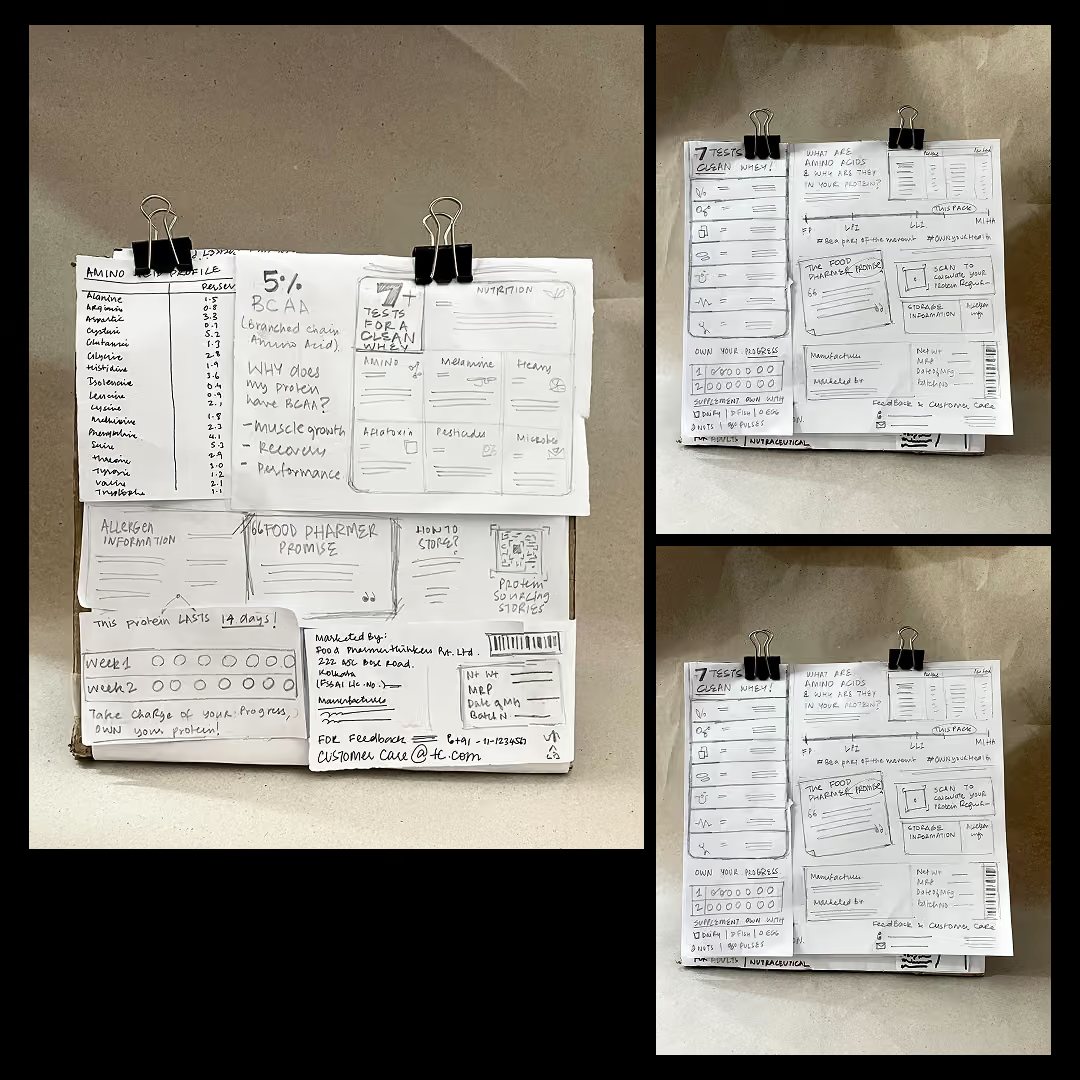
Three photos of handwritten notes clipped together with binder clips, featuring nutritional and health information. The notes include a table of amino acids, mentions of 5% BCAA (branched-chain amino acid), benefits like muscle growth and recovery, allergen information, a protein lasting 14 days, and a weekly progress chart. Other pages discuss tests, food sharing, manufacturing info, and customer care contact details.
Collage of product packaging and label designs including a fermented drink bottle with hand-drawn fermentation diagram and benefits, nutrition facts panels for various foods, a compost bag with detailed usage instructions, colorful barcodes, a cookie dough wrapper, a milk carton, and other packaging and informational layouts on a purple background.
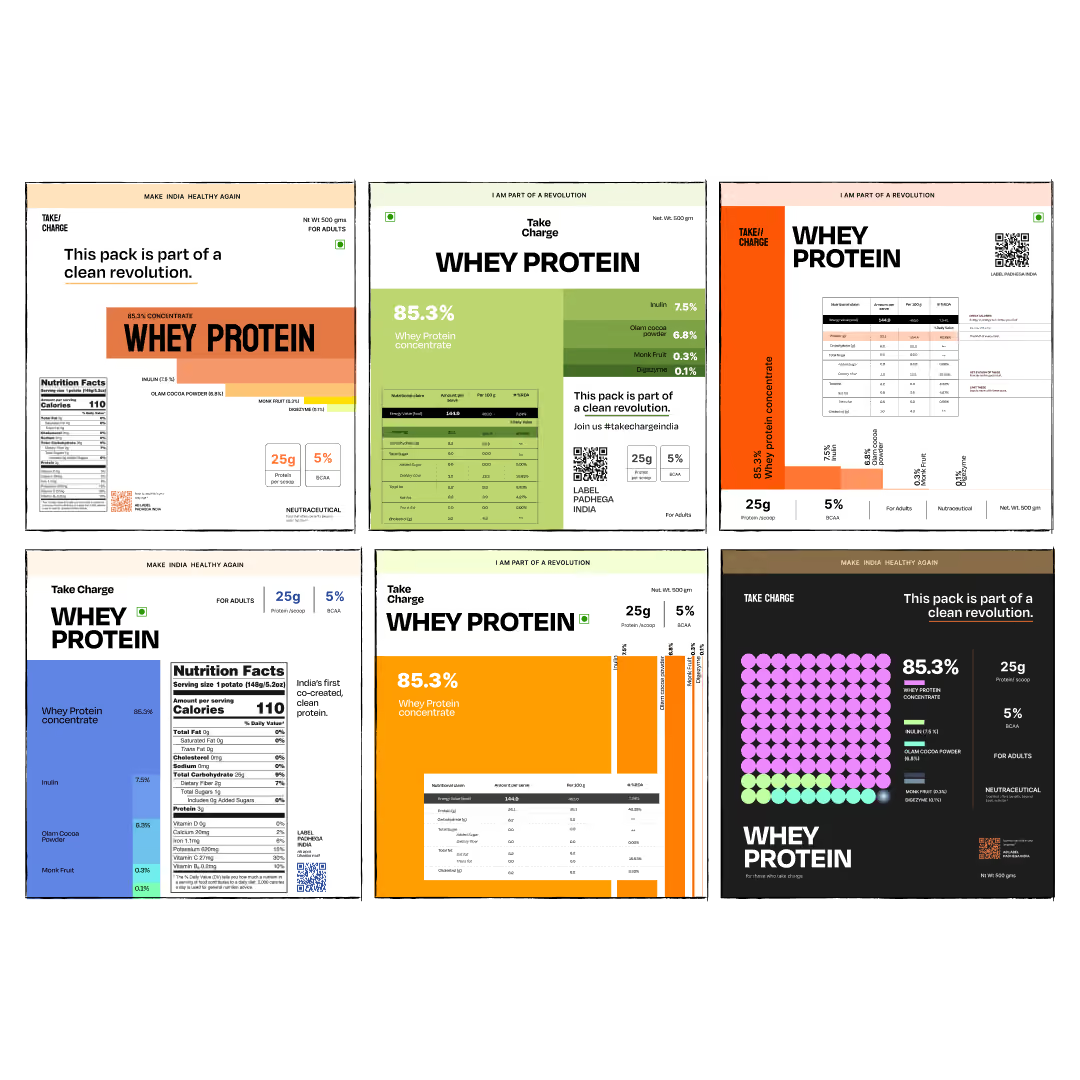
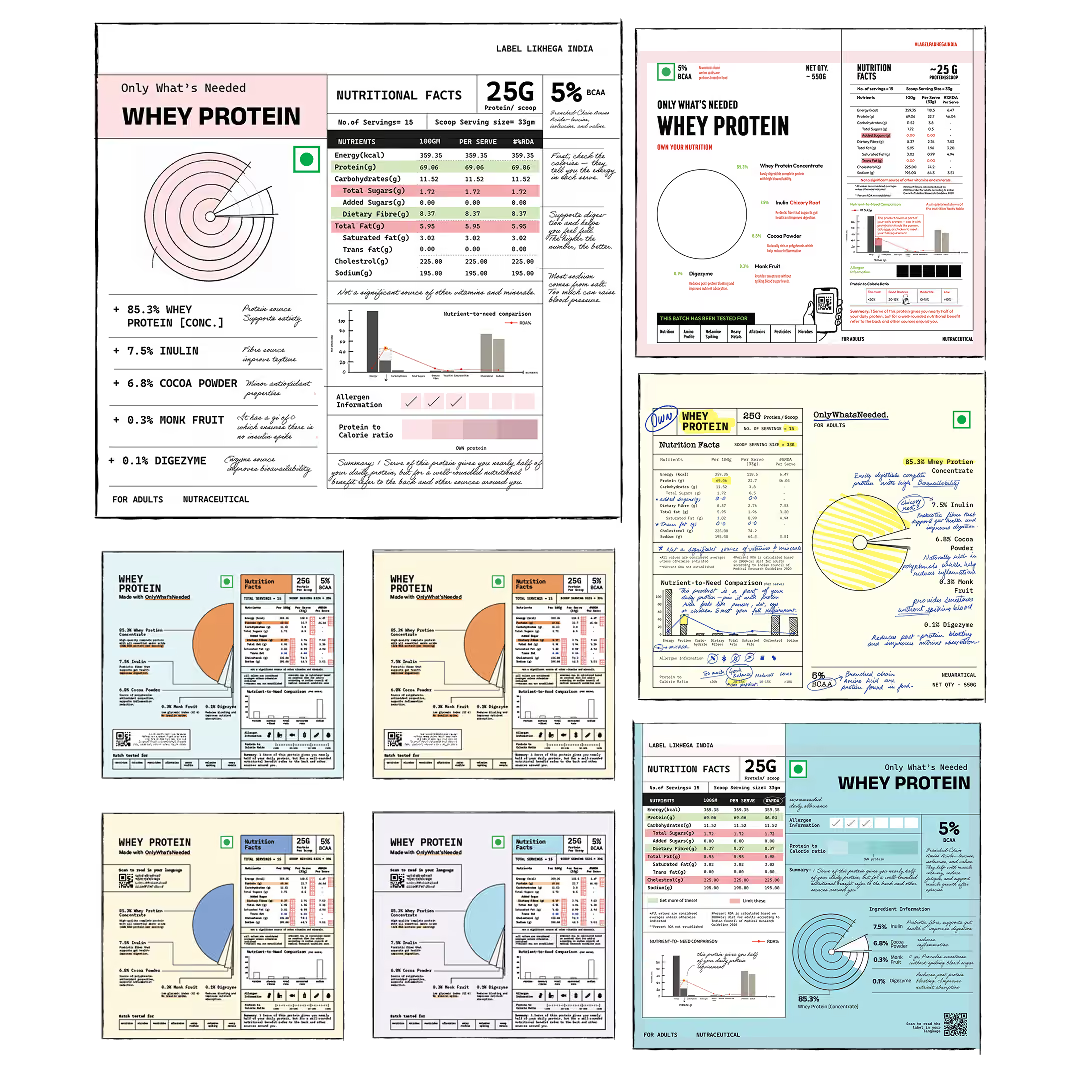
Collage of six different Take Charge WHEY PROTEIN labels showing nutritional information, protein content percentages, and product details; labels feature text such as 'This pack is part of a clean revolution,' '85.3% Whey Protein concentrate,' and product nutrition facts including calories, protein amounts, and other nutrients. The designs use various background colors including white, green, orange, black, and blue with tables, charts, and QR codes included.
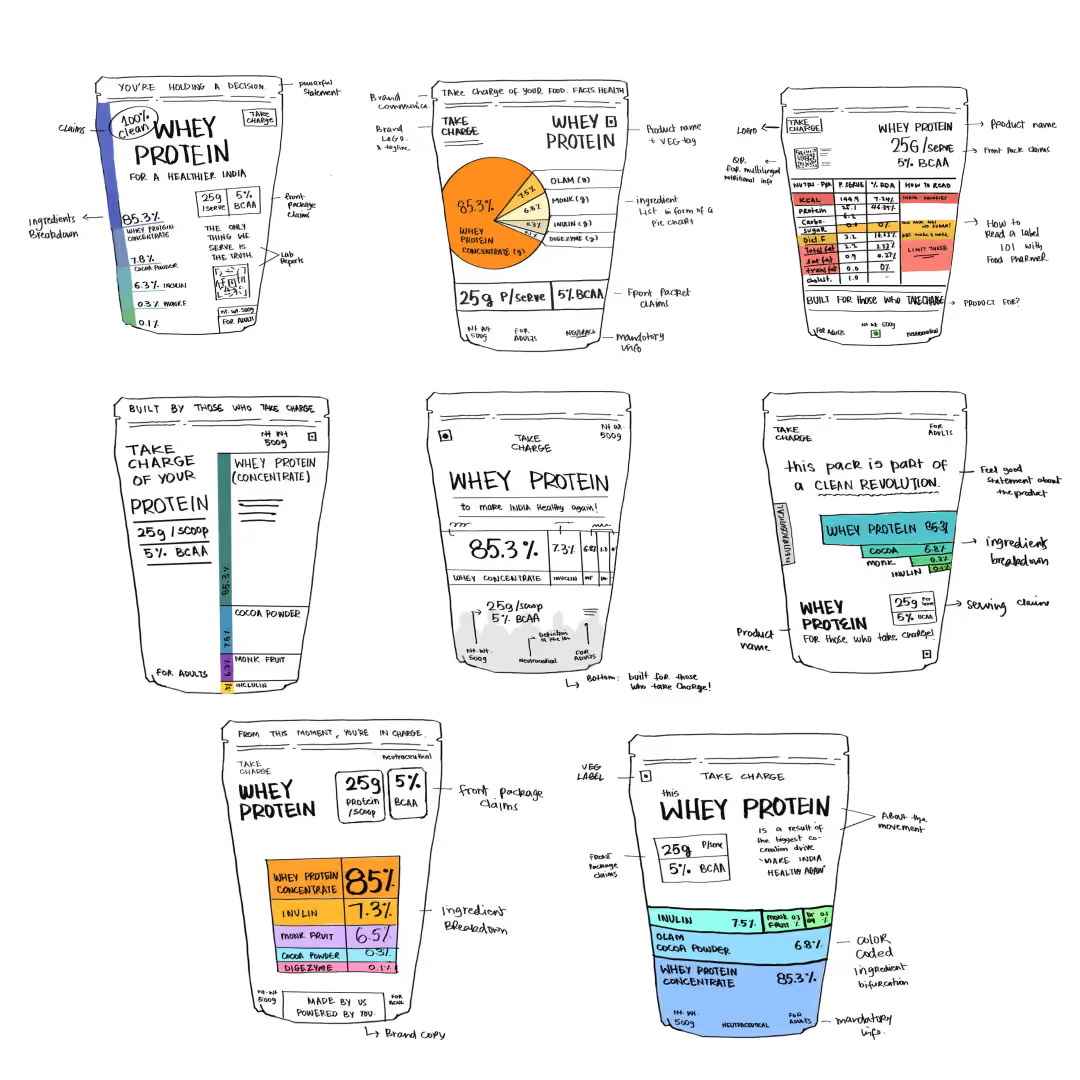
Nine hand-drawn sketches of whey protein packaging designs with annotations highlighting features such as protein content, BCAA percentage, ingredient breakdowns color-coded in pie charts and bars, front package claims, and motivational statements like 'Take Charge' and 'Built by those who take charge.' Colors and layout vary in each design, showing experimental label styles focusing on transparency, nutrition facts, and brand messaging.
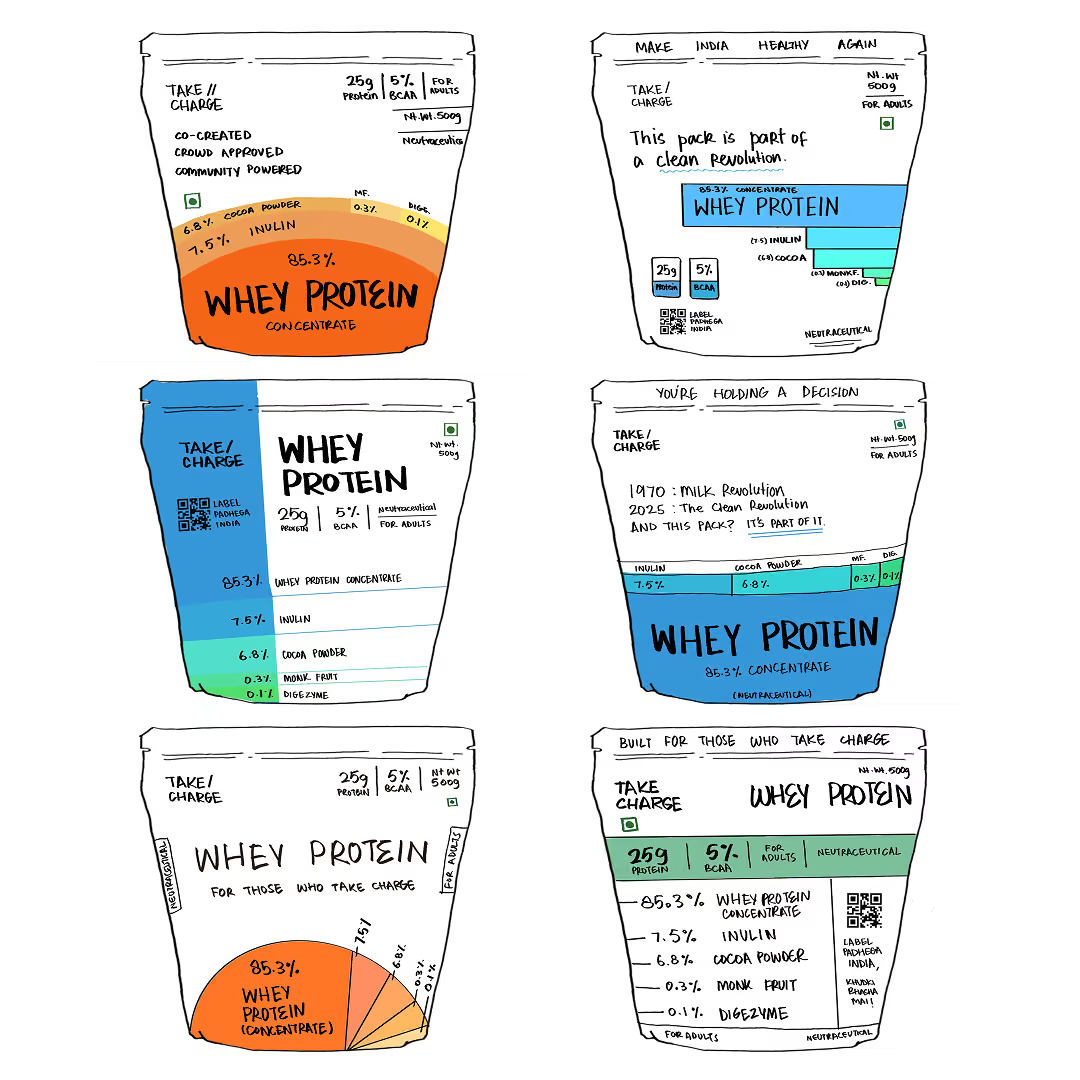
Six illustrated whey protein powder package designs with hand-drawn text and charts showing composition including 85.3% whey protein concentrate, 7.5% inulin, 6.8% cocoa powder, 0.3% monk fruit, and 0.1% digezyme, emphasizing clean ingredients and health benefits, featuring phrases like 'Take/Charge,' 'Make India Healthy Again,' and 'You're Holding a Decision.'
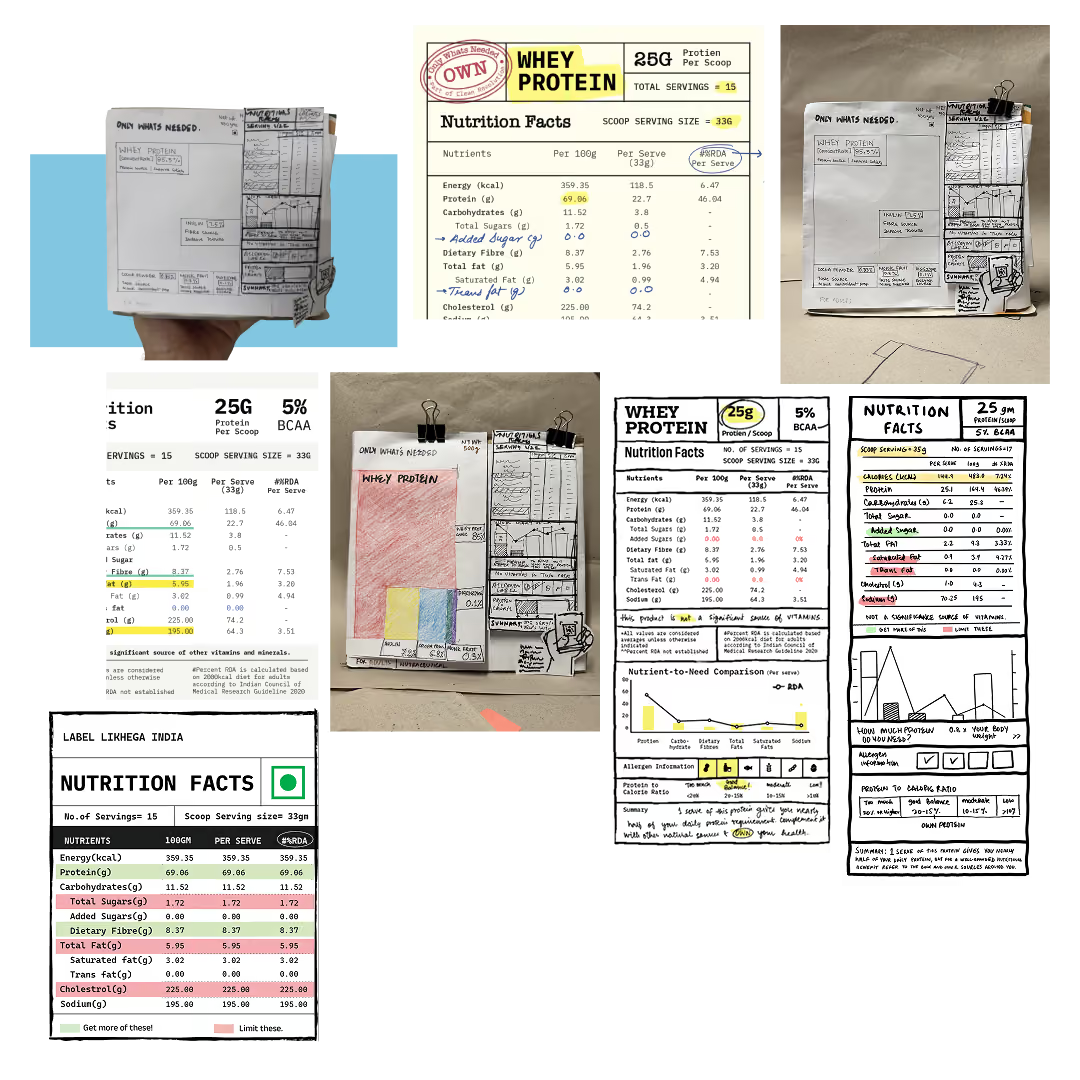
Collage of various hand-drawn and printed nutrition labels for whey protein, showing nutrition facts like energy, protein, carbohydrates, fats, fiber, cholesterol, sodium, and added sugars per 100g and per serving, with annotations, highlights, and comparison charts illustrating protein content, BCAA, and nutrient-to-need ratios.
Collage of nine whey protein nutritional labels and information sheets displaying protein content, percentages, ingredient breakdowns, nutrient tables, pie charts, and graphs with values for calories, carbs, sugars, fats, fiber, and allergen information.
Two photographs showing a person holding light blue packaging with detailed nutritional information and ingredient descriptions, including a pie chart of ingredients and nutrition facts panel; text on the packaging emphasizes natural contents without preservatives, flavors, colors, or artificial sweeteners.
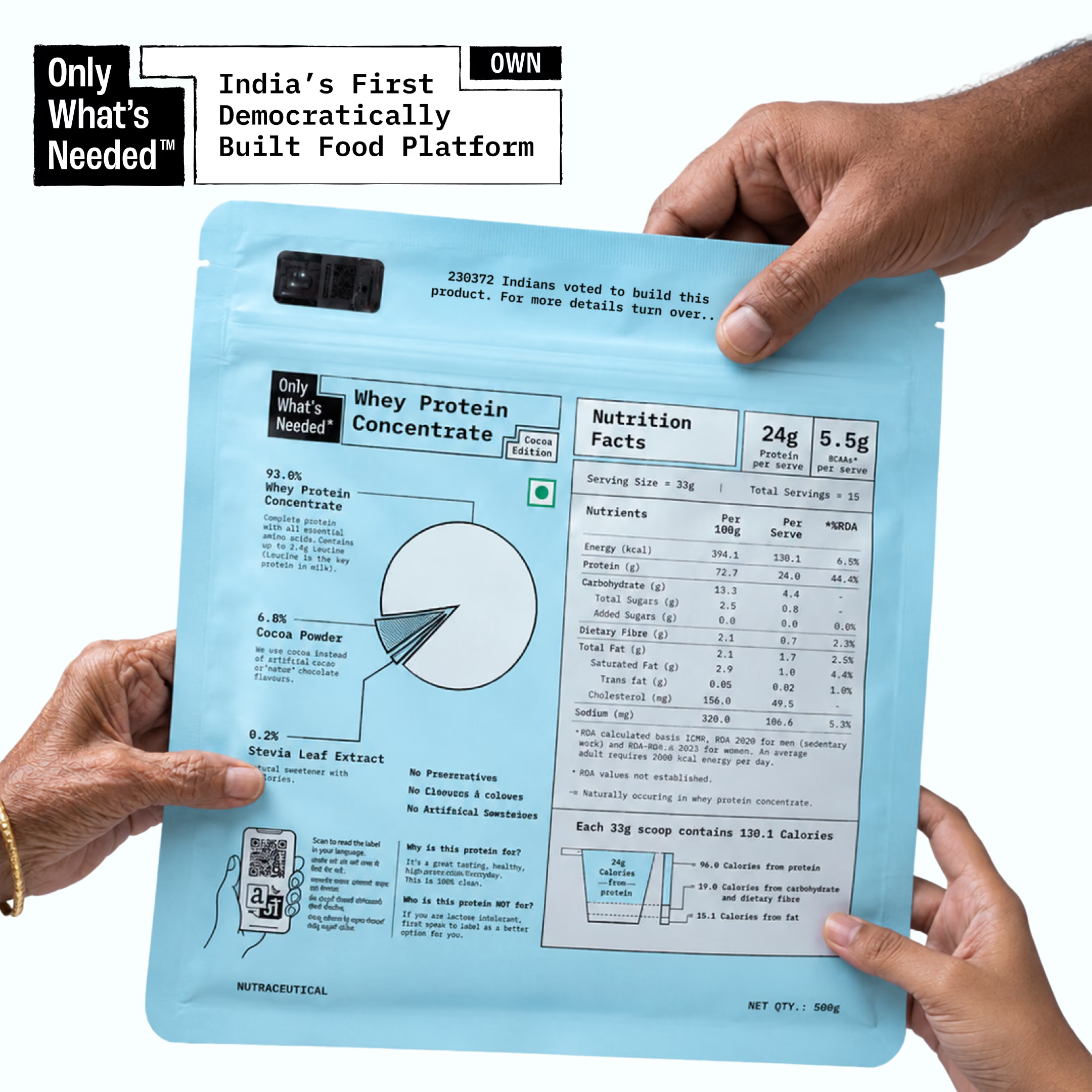
Hands holding a light blue resealable pouch of Only What's Needed Whey Protein Concentrate Cocoa Edition showing nutritional facts, ingredient breakdown into whey protein concentrate, cocoa powder, and stevia leaf extract, along with product claims like no preservatives, no clabbers and coloves, and no artificial sweeteners, plus details about caloric content and serving size.
Then built the brand around it. Ingredients, proportions and nutrition came forward. The information people had been taught to hunt for became the main event. We built the identity around it. Product and flavour establish what you’re looking at. Protein quantity, ingredients and nutrition follow in a defined order. Each part has a place, so the pack can hold detail without giving everything equal weight. The pack became the blueprint for the brand. It was where the promise had to hold up.

The information became the visual language.

The ingredient list became a graphic you could read alongside the numbers. You can see how the components relate, then look closer at the words and percentages. Nutrition facts sit in the same visual world as the name. They get space, structure and a role in the first impression.A brand asking you to read the label should make it worth your attention.
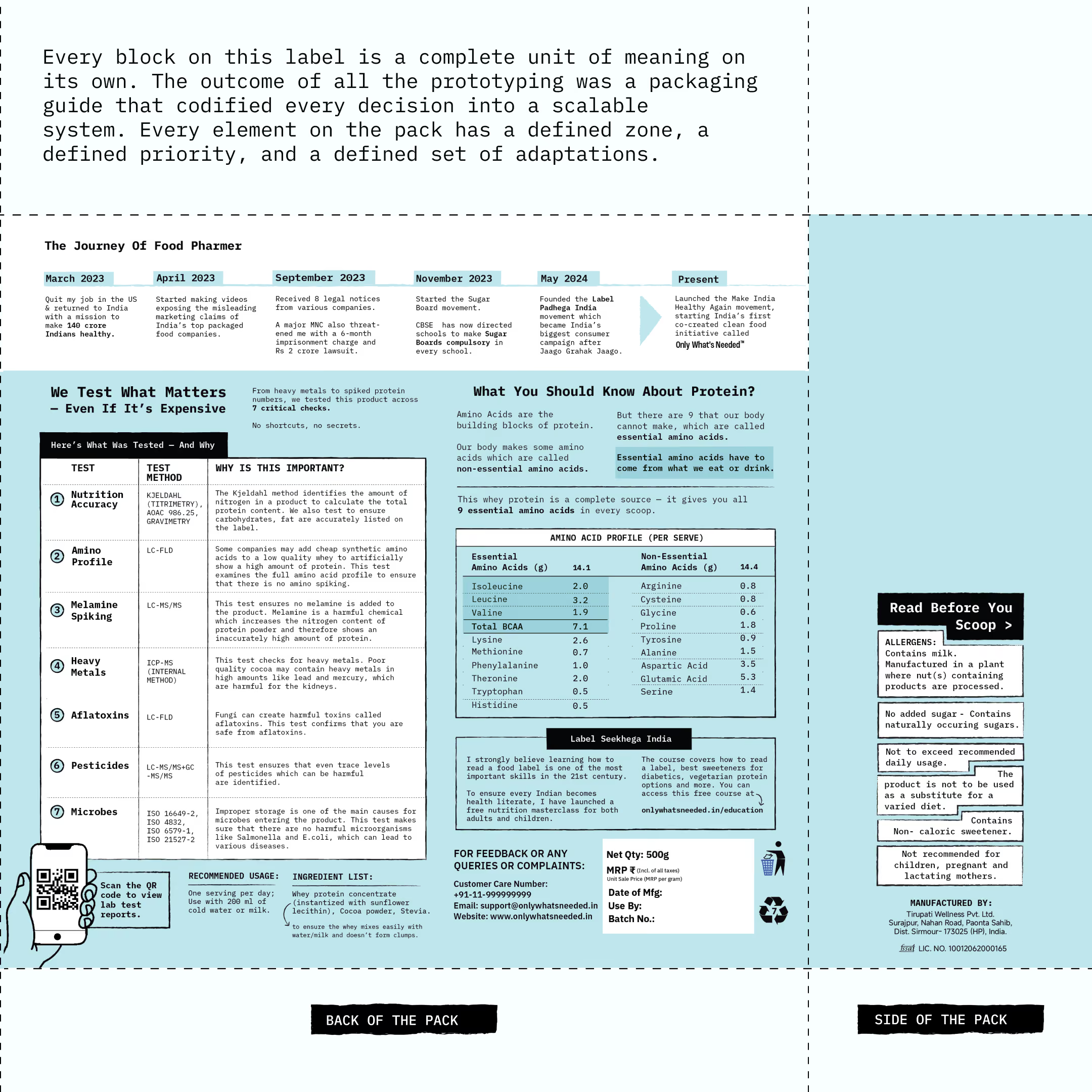
Nutrition label for 24g Whey Protein Concentrate Cocoa Edition showing 93% whey protein concentrate, 6.8% cocoa powder, 0.2% stevia; states no preservatives, flavors, colors, or artificial sweeteners; nutrition facts with 124.5 kcal per serving, 24g protein, 7g BCAA; pie chart of protein content; mentions 7 quality tests like nutritional profile, heavy metals, melamine, amino acid, microbes, aflatoxins, pesticides; usage instructions with storage advice; QR code for language options; marked as made in India.A detailed label layout explaining a food product's packaging and testing process, titled 'The Journey of Food Pharmer' with timelines from March 2023 to present describing milestones like quitting US export, video marketing, legal notices, market changes, product launch, and current status. Sections include 'We Test What Matters' describing testing methods for nutrition accuracy, amino profile, melamine, heavy metals, aflatoxins, pesticides, and microbes. 'What You Should Know About Protein?' explains essential and non-essential amino acids and their benefits. The label has safety, usage instructions, contact info, and allergy warnings, plus disclaimers about sugar, additives, and dietary suitability. There are QR code scanning and recycling symbols.

A brand that expects you to read it.

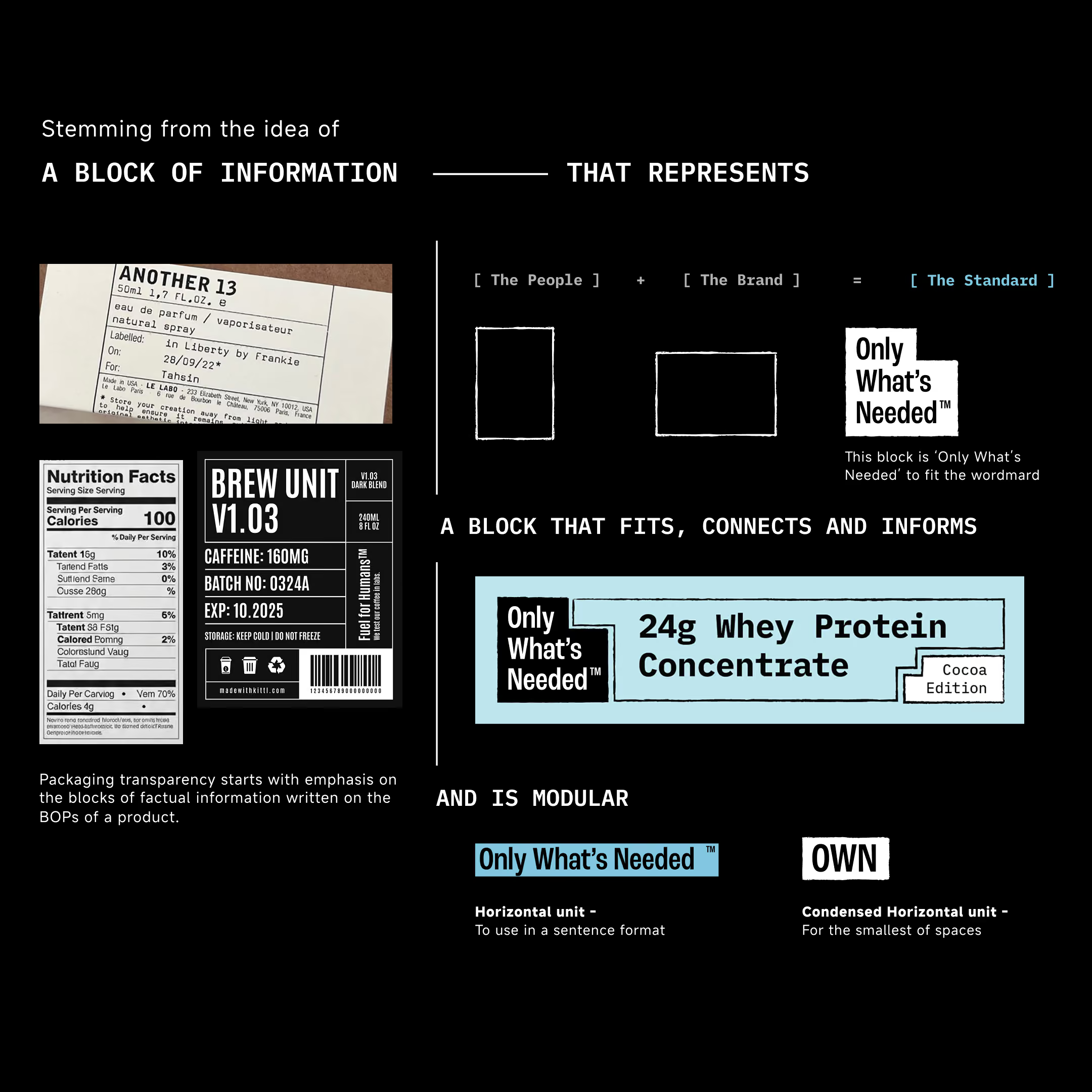
The wordmark is a compact block. It joins the product name and flavour label, giving the pack a recognisable shape before you get into the detail. Outlined panels, strong type and ingredient graphics turn the information into a visual rhythm. Colour gives it presence. The connected blocks hold it together. That is where the character comes from. The things OWN wants people to understand are also the things that make it look like OWN.

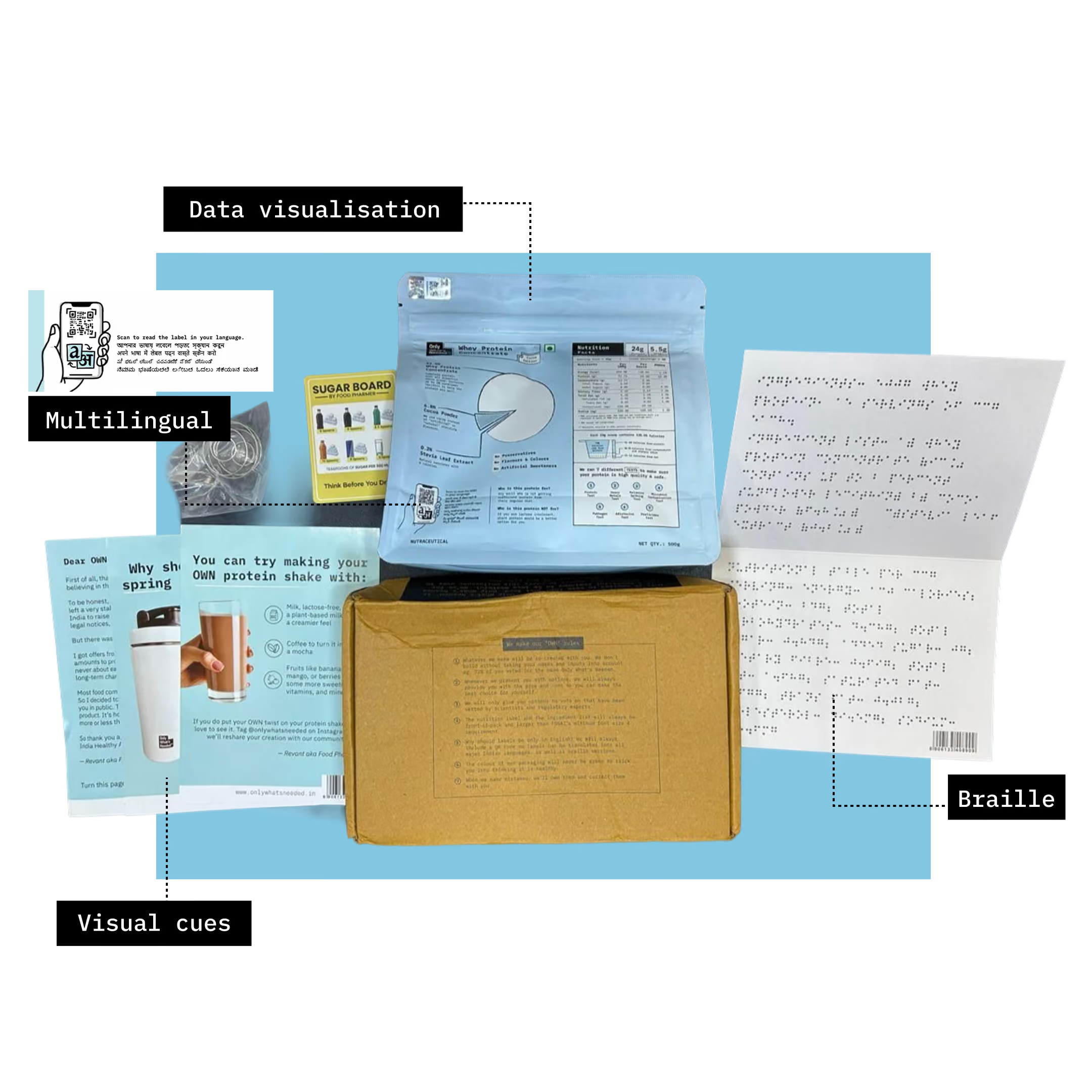
Who gets to read the label? Someone comfortable with English? Someone familiar with nutrition terminology? The invitation to participate had to carry through to access. A QR route opens label information in multiple Indian languages, with visual cues explaining how to use it. Ingredient graphics offer another way into the composition. Braille on the outer packaging extends that consideration beyond the printed pouch.If the information is meant for people, the design has to consider how different people receive it.
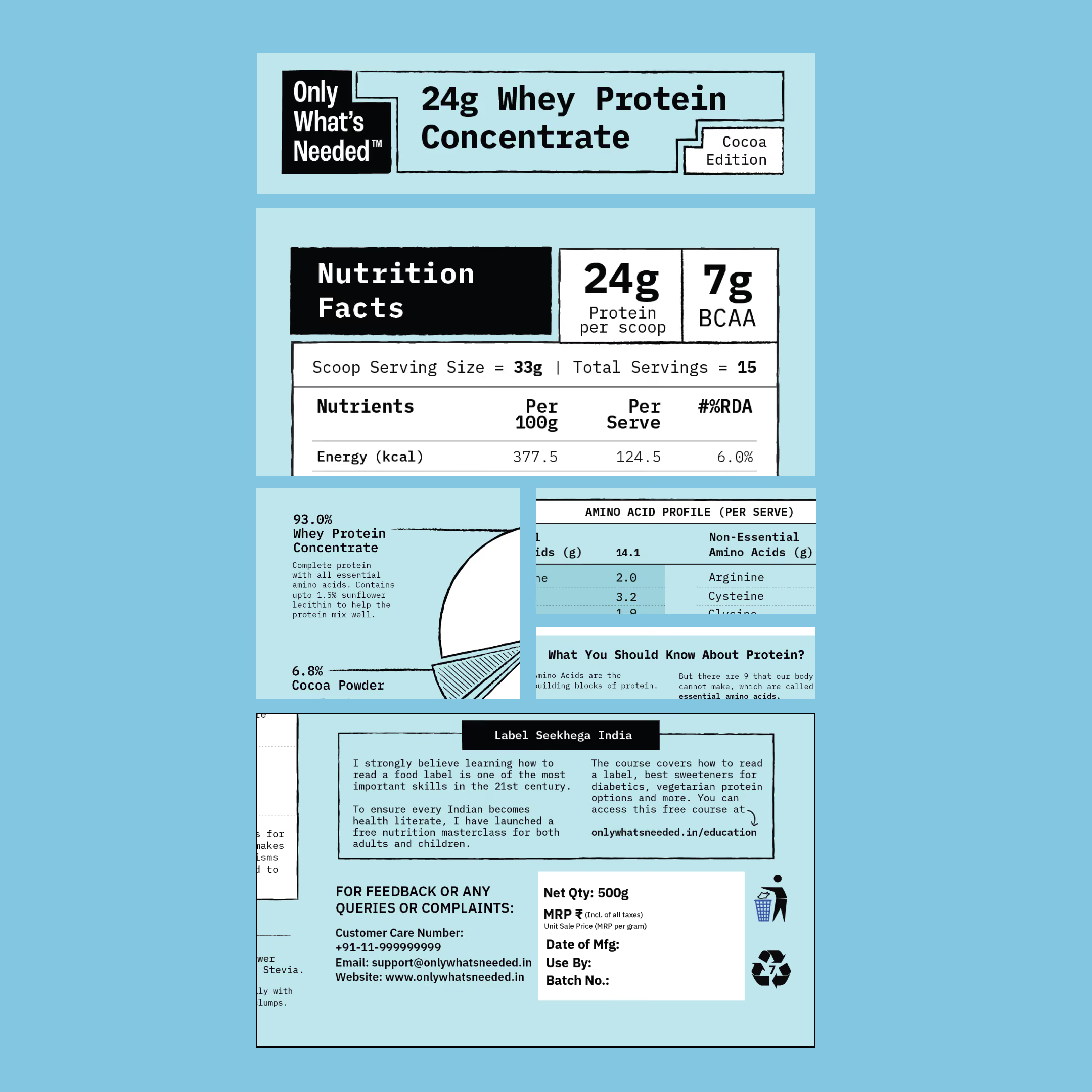
Graphic explaining the concept of a block of information representing a modular standard connecting people and brand, using product labels and packaging text examples; highlights 'Only What's Needed' as a block that fits, connects, informs, and is modular for packaging transparency.Nutrition label of Cocoa Edition whey protein concentrate showing 24g protein and 7g BCAA per 33g scoop, with 93% whey protein concentrate and 6.8% cocoa powder content, amino acid profile per serving, and educational info encouraging Indian learners to understand food labels and promoting a free nutrition masterclass at onlywhatsneeded.in/education.A flat lay showing accessible food packaging with multilingual text, visual cues, braille labeling, and a data visualization pie chart on the protein powder package on a light blue background.

The next pack should keep the same promise.

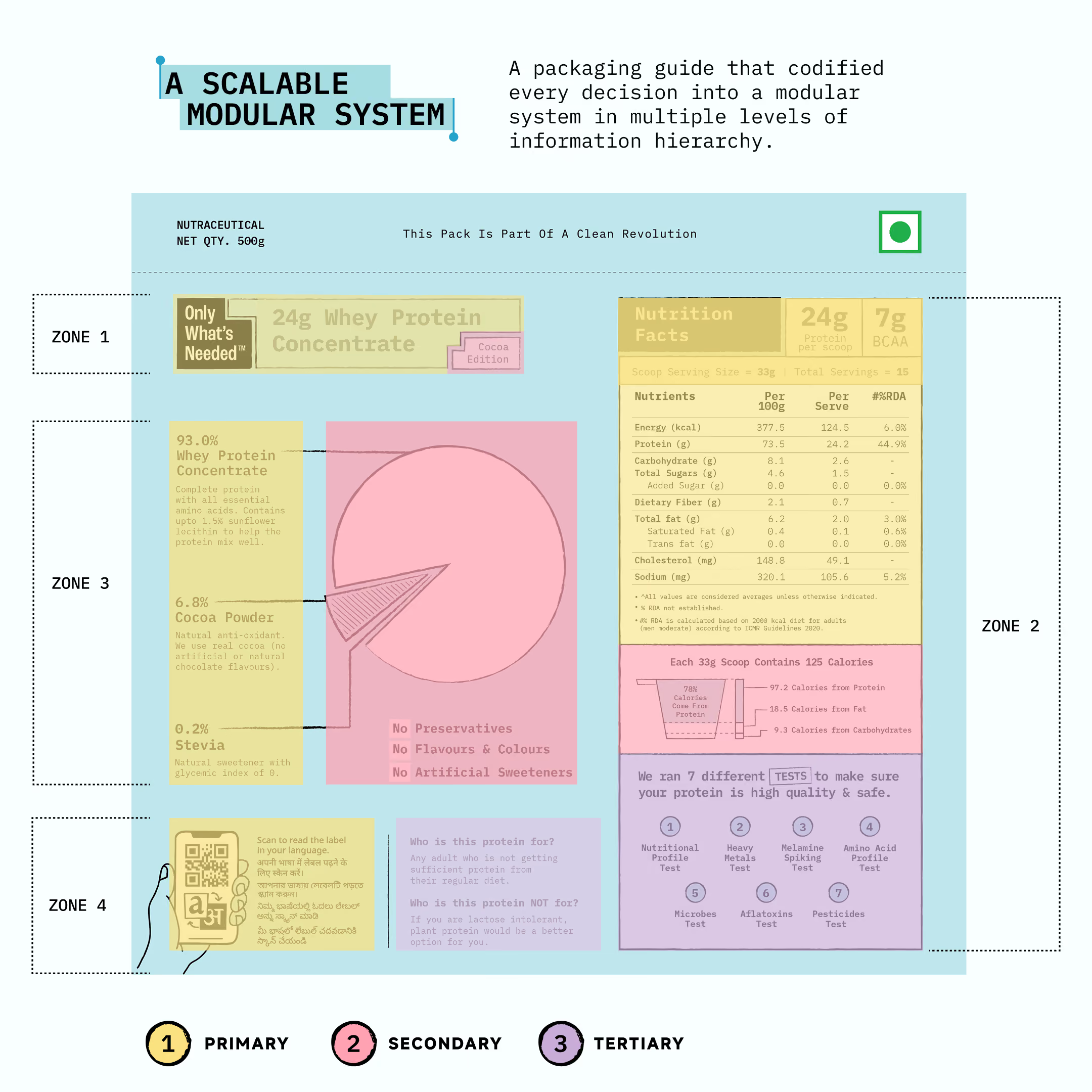
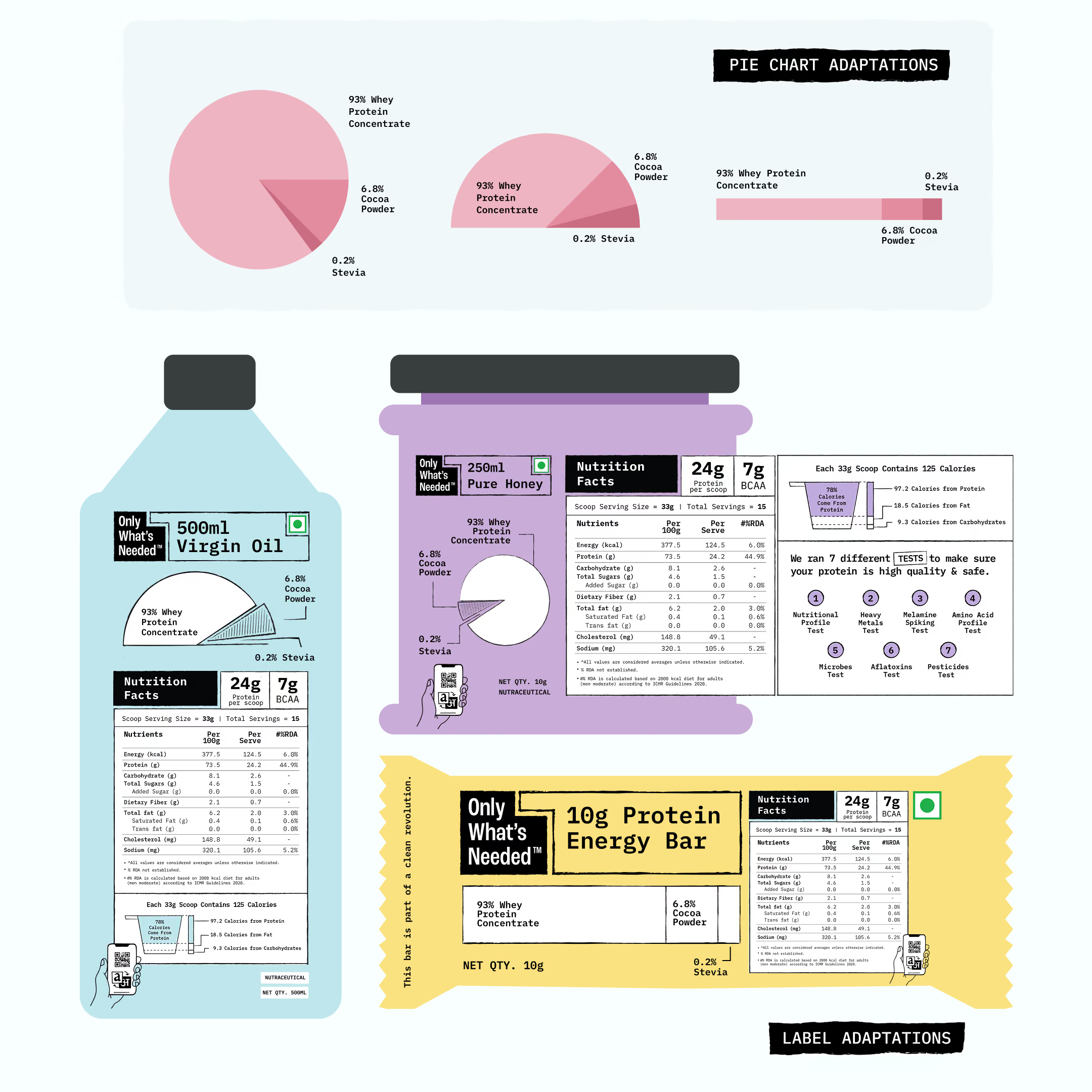
We put the rules into a packaging guide: what stays fixed, what can change, and which information gets priority.A longer product name needs room. A smaller format needs a different layout. The system lets those parts move while keeping the information priorities intact. Pouch, bottle, jar, wrapper: the format studies explore how that logic could travel. The shape can change. The commitment to clear information carries through.

The identity appears on the released protein packaging, where the ingredient graphic, nutrition panel and product-name unit work together. The outer packaging and accompanying printed material extend the experience beyond the pouch. The pouch starts the conversation. The outer packaging and printed material give it more room, including information in other formats
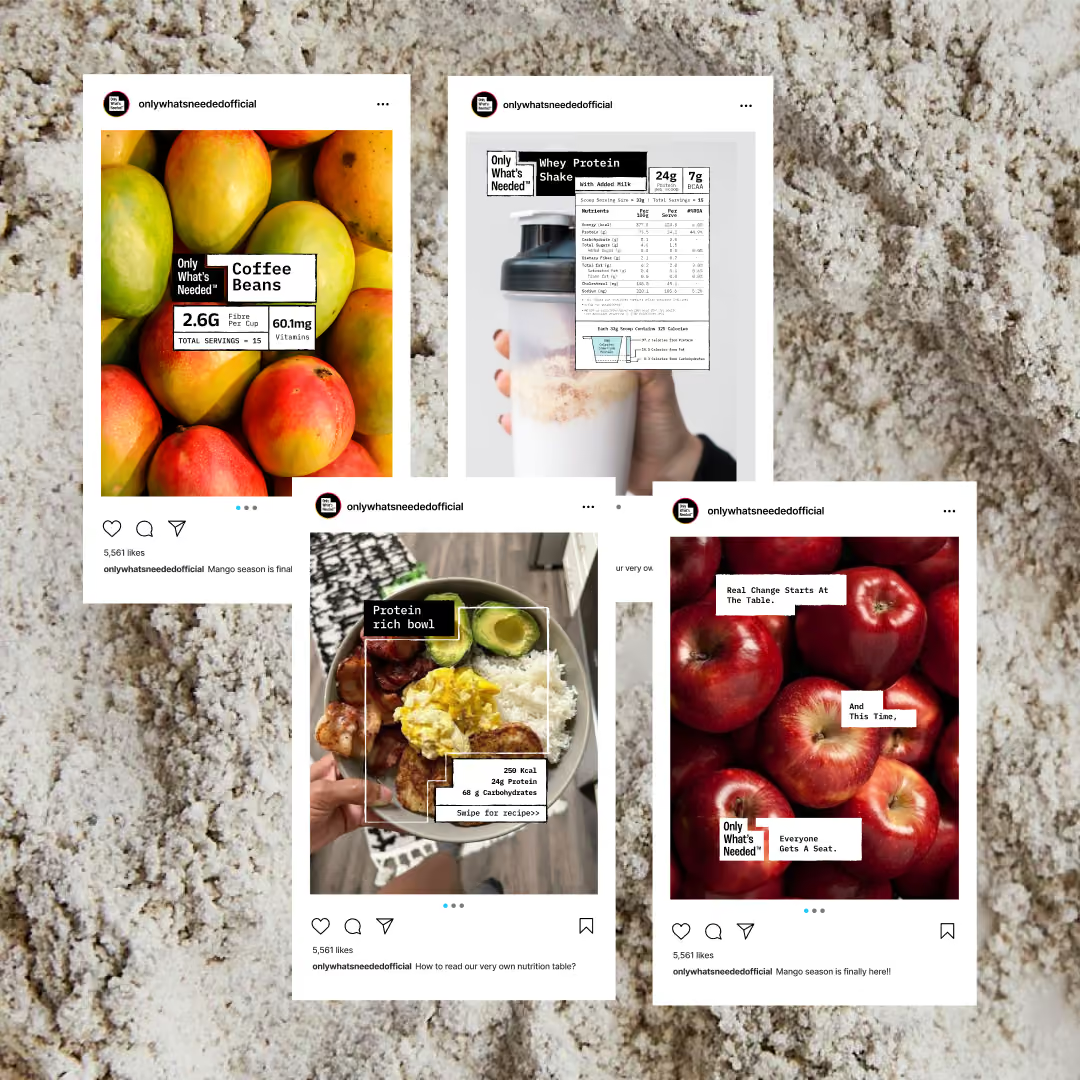
Diagram titled 'A Scalable Modular System' showing a packaging guide divided into four zones with a blue background. Zone 1 highlights the product name '24g Whey Protein Concentrate Cocoa Edition.' Zone 2 shows Nutrition Facts with protein, calories, fats, and other nutrients, plus a calorie source breakdown and tests conducted for quality. Zone 3 contains ingredient percentages with whey protein concentrate at 93%, cocoa powder 6.8%, and stevia 0.2%, plus a note of no preservatives or artificial sweeteners. Zone 4 includes a QR code for label reading in multiple languages and information on target consumers. Color-coded labels mark primary, secondary, and tertiary information levels.Illustration showing adaptations of a pie chart into different formats and packaging labels for nutritional products. The top section displays three pie chart variations representing 93% Whey Protein Concentrate, 6.8% Cocoa Powder, and 0.2% Stevia, including a full pie, a semi-circle, and a horizontal bar chart. Below are three product labels: a blue 500ml Virgin Oil bottle with a small pie chart and detailed nutrition facts, a purple 250ml Pure Honey jar with a semi-circle chart and nutrition facts, including energy, protein, carbs, fats, and BCAA content, and a yellow 10g Protein Energy Bar wrapper with a horizontal bar chart, nutrition facts, and BCAA details. The image emphasizes visual adaptations for data presentation and product labeling.Four Instagram-style posts on a textured background: One shows ripe mangoes labeled as coffee beans with 2.6g fiber and 60.1mg vitamins; another shows a hand holding a protein shake bottle with nutrition facts; the third shows a protein-rich bowl with rice, eggs, avocado, and meat labeled with calories and protein; the last shows red apples with text about real change starting at the table and everyone getting a seat.

People started sharing the label.

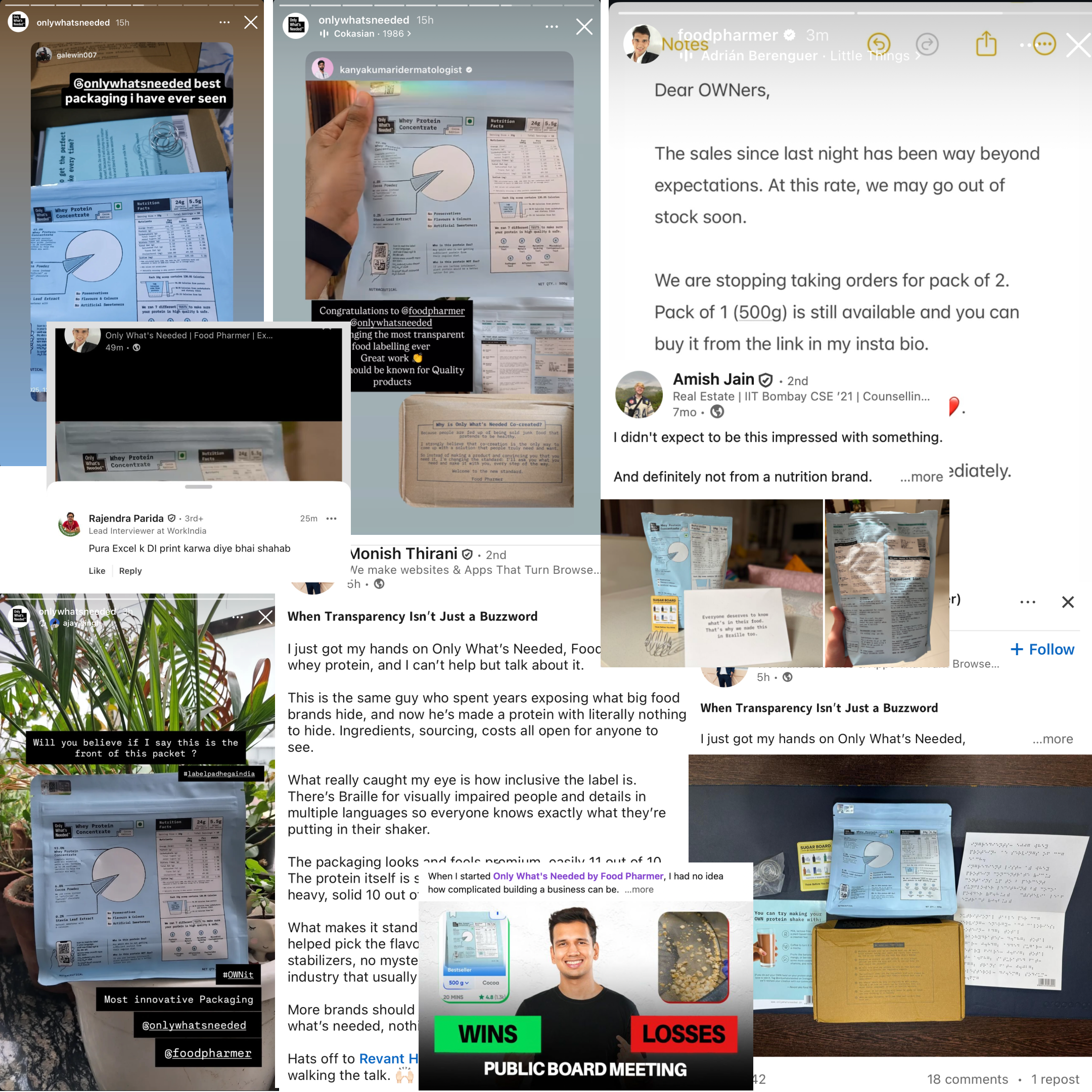
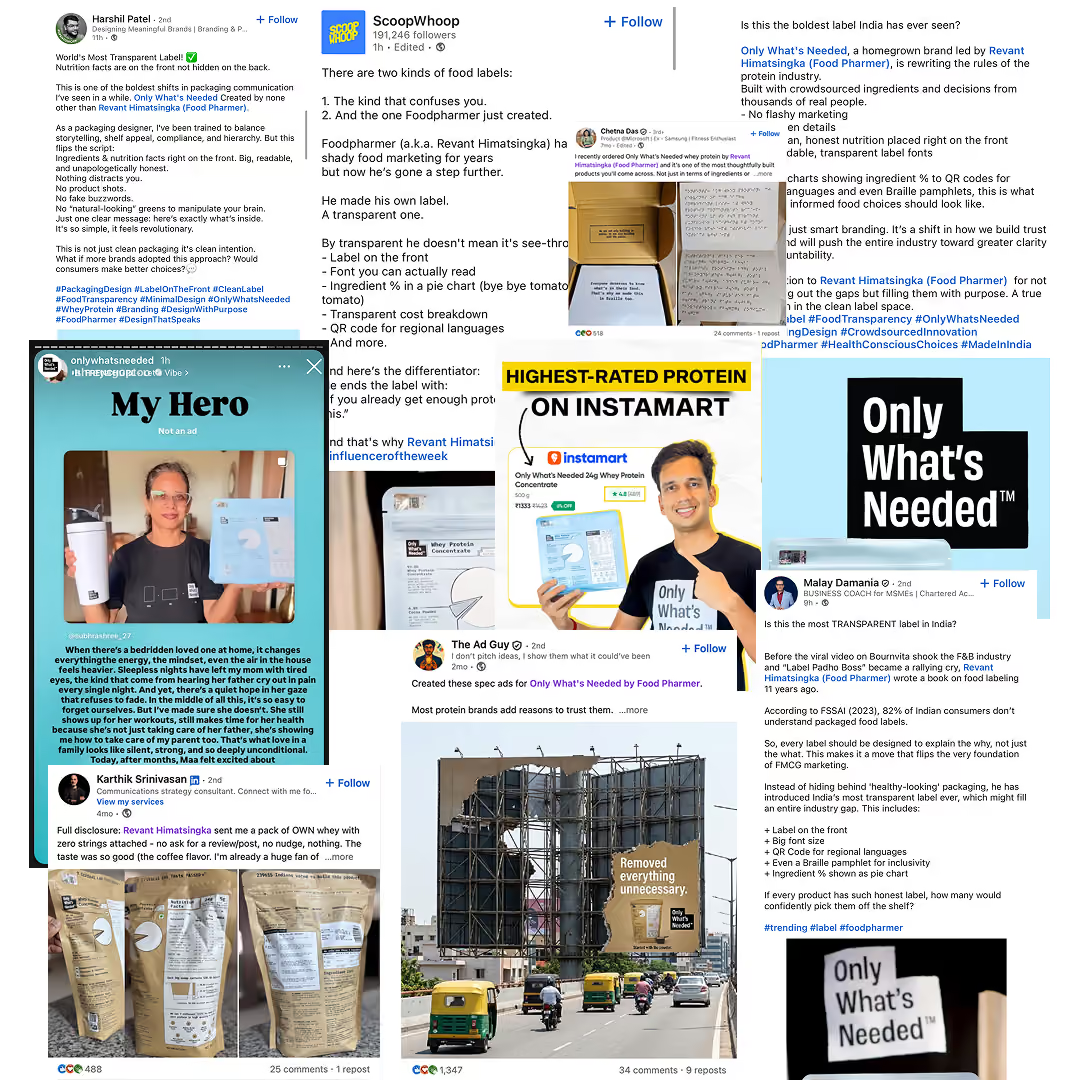
After launch, public posts drew attention to the packaging, ingredient breakdown and information hierarchy. People photographed the packs and discussed the details, including language access and Braille on the outer packaging.People were sharing the very thing food packaging often asks them to work hardest to understand: the label.The public process and the finished pack now had something in common. Both invited people to look closer.
Collage of social media posts praising the packaging of Only What's Needed whey protein concentrate by Food Pharmer. Images show blue product packaging with detailed nutrition facts, a pie chart, Braille label for visually impaired, and ingredient information. Text by users highlights transparency, inclusivity, and innovative labeling, including sourcing, costs, and no unnecessary additives. One post announces stopping orders for 2-pack due to high sales. A person holds the product packet in some images, emphasizing the premium and informative design. Positive user reactions are evident across platforms.Collage of social media posts and tweets highlighting 'Only What's Needed,' a transparent food label created by Revant Himatsingka to improve packaging transparency and consumer trust with features like ingredient lists, QR codes, and clear front labeling, praised for its boldness and clarity in the Indian food industry.

Built with people. Built to be questioned.

People questioned the name. They contributed to decisions about the food and what the label should say. Those questions gave the brand something valuable to build from.Our job was to give that participation direction, then give the direction a form you could recognise, pick up and read.

That is the work we do at Studio Sorted: find the idea that matters in a brand’s context, make it actionable, and make it look as compelling as it deserves to.

Launching, rethinking or growing a consumer brand? Let’s find what it should be built around.
Team
Brand strategy, identity, and packaging system for Only What’s Needed (OWN) were designed by Studio Sorted in collaboration with FoodPharmer (Revant Himatsingka) and the public community that participated in shaping the brand.

Creative Direction: Abhishek Durani
Brand Strategy: Abhishek Durani, Vrinda Gupta
Graphic design: Anshul Gupta, Shreya Agarwal
Copywriting: Kashish Choudhary
FAQs
Who designed the Only What’s Needed brand?
Studio Sorted designed the brand strategy, identity, and packaging system for Only What’s Needed (OWN) in collaboration with FoodPharmer Revant Himatsingka.
‍
What is Only What’s Needed?
Only What’s Needed (OWN) is a transparent food brand focused on clean ingredients and clear labeling.
‍
What makes OWN packaging unique?
OWN packaging prioritises information hierarchy, ingredient transparency, and accessibility, making labels easier to read and understand.

What is participatory branding?
Participatory branding involves building a brand with input from its audience/users, allowing users to influence decisions such as naming, packaging, and communication systems.

‍What is transparent food packaging?
Transparent food packaging is a system where all relevant product information is presented clearly, without manipulation, omission, or marketing bias.